Roofing Palo Alto

Re-roofing Palo Alto, from 3:12 Eichler gables to Professorville shingle

Every re-roof in Palo Alto needs a building permit, and a like-for-like job on a detached house or duplex can be issued instantly online, but only to a licensed contractor with an account in the city's permit system and never on a historic property. What goes on top depends on the house: some 2,700 Eichlers with tar-and-gravel or rolled roofing, Professorville's shingle and tile, and Class A roofs in the Palo Alto Hills.

  • Free to request, no obligation to hire
  • Up to five local pros who take this work can reply
  • Rules on this page checked against 13 public sources, October 2026
Re-roof permit
Always required; instant online for like-for-like, non-historic
Eichler tracts
31 of them, built from 1949 to 1974
Energy Code zone
Climate Zone 4, ZIP codes 94301 through 94306
Homes in the WUI
More than 130, per the Palo Alto Fire Department

The work

Five Palo Alto roof jobs and what shapes each one

  • Re-covering a tar-and-gravel Eichler roof

    Palo Alto's Eichler guidelines, which are voluntary, ask for replacement roofing with a plain appearance where the street can see it, and name tar and gravel, single-ply, foam and composite shingles. Standing-seam metal is not encouraged. They ask owners to keep the thin roof edges, overhanging eaves, exposed beam ends and wood fascia, not to box in beam ends or wrap fascia in aluminum or vinyl, and to look at insulated roofing that pairs with those materials.

  • Gable roofs that are steep under the code

    The Energy Code treats a roof as low-sloped only below 2:12, so a 3:12 Eichler gable counts as steep: replacing more than half of it calls for an aged reflectance of 0.20 with emittance of 0.75, or an SRI of 16, unless an equivalent applies. On a flat-with-shed Eichler the flat bay falls under the low-slope rule, with its 0.63 reflectance and R-14 continuous insulation unless R-10 is already there. One house can carry both rules, so ask the bid to say which section of roof meets which.

  • Re-shingling the Community Center tract

    Shingled Eichlers are uncommon, and the Community Center tract of 1973 is the example the city's guidelines give. Where shingle roofs were original, the preferred treatment is to re-roof with shingles again rather than switch to a flat-looking membrane. Composite shingles also appear on the guidelines' list of plain roofing that suits Eichlers elsewhere, so a shingle bid here is the expected choice, not an exception that needs explaining.

  • Wood shingle and clay tile in Professorville

    The district's design guidelines, dated October 2016, ask owners to keep existing wood shingle and clay tile roofs where feasible and, when replacement is necessary, to match the color, shape and size of the historic material. They also ask owners to avoid standing-seam metal, which was never found there, and not to box in exposed rafter tails, replacing rotten ones with new members of the same profile. A roof construction weighing 25 pounds per square foot or more, as heavy tile can, is exempt from the cool-roof reflectance rule.

  • Chimneys and sprinklers when the job grows

    Palo Alto's amendments to the residential code require a spark arrester on the existing chimney whenever any repair, replacement or alteration is made to the roof of an existing house. A separate amendment requires automatic fire sprinklers when the roof structure, exterior walls or both are removed, altered or replaced in at least half of the existing building. That trigger names the structure, so a re-roof that grows into new rafters across the house is worth raising with the Building Division early.

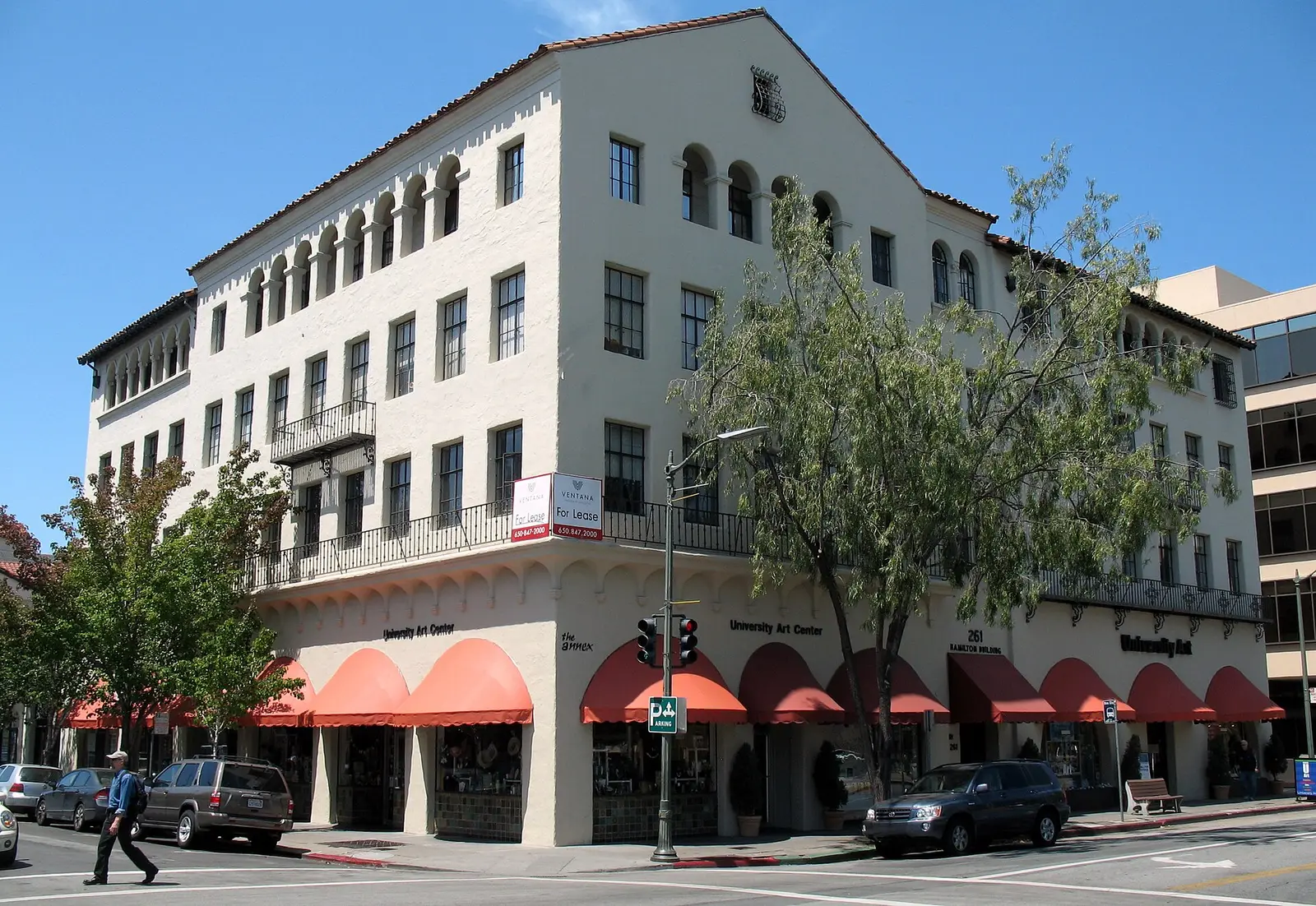
The Ramona Street Architectural District in downtown Palo Alto
The Ramona Street Architectural District in downtown Palo Alto. Photo: Sanfranman59, CC BY-SA 3.0, via Wikimedia Commons.

The houses here

Flat, shed and chevron roofs over post-and-beam frames

Joseph Eichler built some 2,700 of his houses in Palo Alto, in 31 tracts running from University Gardens in 1949 to Los Arboles Addition No. 2 in 1974. The city's Eichler guidelines describe their roofs as low-slope gables, flat roofs, flat-and-shed combinations and, in Greenmeadow alone, a chevron, with slopes often near 3:12 and coverings that look flat: tar and gravel or rolled roofing. In the early 1970s Claude Oakland added center-gable, turned-gable and hipped roofs, and the Community Center tract is one of the few with shingles. Near downtown, Professorville mixes Colonial Revival and Craftsman houses, gambrels that point to Dutch Colonial influence, and Mission-style homes under red clay tile.

Free request

Describe the roofing job once. Local pros who take work in Palo Alto reply by call or text.

  • No fee to request, and no obligation to hire
  • You agree scope and price with the pro you choose
  • Photos help them quote without a first visit

Get quotes for roofing work in Palo Alto

Two short steps. A local pro who takes this work calls or texts you back.

To send a request, call or text (415) 449-8213.

Free to request, and you agree the scope and price with the person you hire before work starts. In California, a job over $1,000 in labor and materials, or one that needs a building permit, must be done by a contractor licensed by the CSLB in the right class. Ask for the license number and check it at cslb.ca.gov.

Permits and local rules

Permits, review and fire rules behind a Palo Alto roof

  • The instant re-roof permit and its limits

    Development Services lists re-roofs among the projects that need a building permit. A like-for-like re-roof can go through the Instant Building Permit, which is limited to licensed contractors with an active Accela Citizen Access account, and only for detached single-family houses and duplexes that are not historic properties. Each instant permit covers one structure, so a detached garage takes its own. A change of roofing material is not like-for-like, so it falls outside the instant permit.

    Source: City of Palo Alto Development Services (paloalto.gov)

  • Group A houses go to the preservation planner

    The city's historic review bulletin defines Group A resources as houses in Historic Inventory Categories 1 and 2, Categories 3 and 4 downtown, and every property in the locally designated Professorville and Ramona Street districts. Any permit application for exterior changes to one of them, ministerial permits included, is routed to the Historic Preservation Planner, who checks it against the Secretary of the Interior's Standards and sends it to the Historic Resources Board if it goes beyond a minor exterior alteration.

    Source: City of Palo Alto Historic Preservation (paloalto.gov)

  • Cool roofs and roof insulation in Climate Zone 4

    Section 150.2 of the 2025 Energy Code applies when more than half of a roof is replaced, including a new layer over the old. Steep roofing in Zone 4 needs an aged reflectance of 0.20 with emittance of 0.75, unless the house has R-38 ceiling insulation, a qualifying radiant barrier, no attic ducts or R-2 continuous insulation at the deck. Low-sloped roofing needs 0.63, reduced by insulation at the deck, plus R-14 continuous insulation with exceptions for roofs already insulated.

    Source: California Energy Commission, 2025 Energy Code (energy.ca.gov)

  • Class A roofs in the hills

    The State Fire Marshal's 2025 maps, released to Palo Alto in February of that year, rate areas generally west of Junipero Serra Boulevard and Foothill Expressway as Moderate and parts of the Palo Alto Hills as High or Very High. In a wildland-urban interface area, Section 507.1 of the 2025 state WUI code requires a roof covering that is replaced, or 50 percent replaced within 12 months, to meet the Class A standard for new construction, and any roofing applied in a repair must be at least Class A.

    Source: City of Palo Alto (paloalto.gov)

State license for this work: C-39 Roofing, B General Building. Look up a contractor's license on the CSLB website (cslb.ca.gov).

Part by part

Where a Palo Alto roof comes with its own expectations

  • Greenmeadow

    Eichler's 1954-55 tract has the chevron roof the guidelines say is found only here, and it has been a National Register district since 2005, which makes its houses historic resources and puts the instant permit out of reach. Greenmeadow, Edgewood and Charleston Meadows also keep Architectural Control Committees that review projects under their CC&Rs.

  • Community Center and Los Arboles Addition

    These late tracts carry Claude Oakland's 1970s roof forms: center gables, turned gables, flat-topped center gables and hips. Community Center was built with shingles, and the guidelines prefer shingles again when those roofs are replaced, so the flat-roof advice that fits most Palo Alto Eichlers does not apply here.

  • Professorville

    The city's oldest historic district is on both the local inventory and the National Register, and since a 1993 boundary change carried it east to Embarcadero Road it takes in about 200 homes. Every house in it is a Group A resource, so a re-roof application is routed to the Historic Preservation Planner, and the district guidelines ask for shingle and tile to be kept or matched.

  • Palo Alto Hills and the Foothills

    The Fire Department counts more than 130 residences in the city's wildland-urban interface, and the 2025 state maps rate parts of the hills High or Very High. A roof replacement here is written around a Class A assembly from the start, and the bid should name the covering, underlayment and details that make it one.

Before you hire

Questions for a Palo Alto roofer before the tear-off

  • Does this job qualify as a like-for-like instant permit, or will a material change or historic status send it through regular review?
  • On a flat-with-shed Eichler, which parts of the roof does the bid treat as steep and which as low-sloped under the Energy Code?
  • If insulation goes above the deck, how will the fascia and roof edge stay as thin as the Eichler guidelines ask?
  • Does the tract have an Architectural Control Committee, as Greenmeadow, Edgewood and Charleston Meadows do, and will it want to see the roofing?
  • Confirm the C-39 Roofing license at cslb.ca.gov and ask who will hold the permit in the city's Accela Citizen Access system.

Questions

What Palo Alto owners ask about their roofs

Can I put a standing-seam metal roof on my Palo Alto Eichler?

The city's Eichler guidelines do not encourage it, preferring tar and gravel, single-ply, foam or composite shingles that look plain from the street. Those guidelines are voluntary in most tracts, but the CC&Rs enforced by an Architectural Control Committee, as in Greenmeadow, Edgewood and Charleston Meadows, may carry more weight. In Professorville the district guidelines ask owners to avoid standing-seam metal altogether.

Why is my Palo Alto roofer asking about the chimney?

Because Palo Alto's residential code amendments require a spark arrester on the existing chimney whenever the roof of an existing house is repaired, replaced or altered. It applies to a plain re-roof as much as to a remodel, so expect it on the inspector's list. If the chimney itself is cracked or loose, that repair belongs to a masonry contractor before the new roofing is flashed to it.

Could replacing my roof mean installing fire sprinklers in Palo Alto?

Only if the work reaches the structure. Palo Alto's amendment requires automatic sprinklers when the roof structure, the exterior walls or a combination of both is removed, altered or replaced in at least half of the existing building. A new covering over sound framing is a different job from replacing rafters across the house, so if rotten framing turns up, ask the Building Division before the scope grows.

Is my Palo Alto house in a fire hazard zone?

It may be if it is west of Junipero Serra Boulevard and Foothill Expressway, which the State Fire Marshal's 2025 maps rate Moderate, or in the Palo Alto Hills, rated High or Very High in parts. The city publishes a map of its local zones, and the State Fire Marshal's site looks up a single address. Confirm the result before comparing roofing bids, since Class A changes what can be offered.

Where these facts come from

Checked against these public sources in October 2026. Rules and programs change: confirm permit requirements with the city before work starts, and a contractor's license on the CSLB website.

  • paloalto.gov: Apply for a Building Permit (paloalto.gov)
  • paloalto.gov: historic resources review info bulletin sep. 2024 (paloalto.gov)
  • paloalto.gov: Project Review (paloalto.gov)
  • paloalto.gov: 2018 04 02 palo alto eichler design guidelines adopted design guidelin (paloalto.gov)
  • paloalto.gov: Professorville Historic District (paloalto.gov)
  • paloalto.gov: 61618 (paloalto.gov)
  • paloalto.gov: Palo Alto Begins Wildfire Preparedness Public Discussions (paloalto.gov)
  • paloalto.gov: Prepare For Wildfire READY SET GO (paloalto.gov)
  • energy.ca.gov: CEC 400 2025 010 F (energy.ca.gov)
  • energy.ca.gov: BuildingClimateZonesByZIPCode ada (energy.ca.gov)
  • gocodebook.com: chapter 16.06 2025 california residential code california code of regu
  • gocodebook.com: section 507 replacement or repair of roof coverings

Roofing work in Palo Alto? Tell us what you see.

One request reaches local handymen and contractors who take this work. The Handyman SF connects you with them; it does not do the work.

HandymanNow for handymen Work in Palo Alto? Get job leads by text. Pick your trades and areas, take only the jobs you want. No subscription. Start getting leads HandymanNow for homeowners Get the HandymanNow app. Send a request with photos, message your handyman and follow them on the way. Download the app

HandymanNow app

Fix it faster. Find work faster.

Homeowners send a job with photos and follow their handyman on the map. Handymen get local jobs by text and take only the ones they want.

Call Get a quote