New cabinets, stone counters and the rules on cutting them
Cabinets and countertops look like finish work, and some Bay Area cities do list them as needing no building permit. The rules show up around them instead: the sink, outlets and cooktop that come out with an old counter can need plumbing and electrical permits, and quartz and high-silica stone must be cut and polished under Cal/OSHA's silica standard, tightened in December 2023 and again in February 2025.
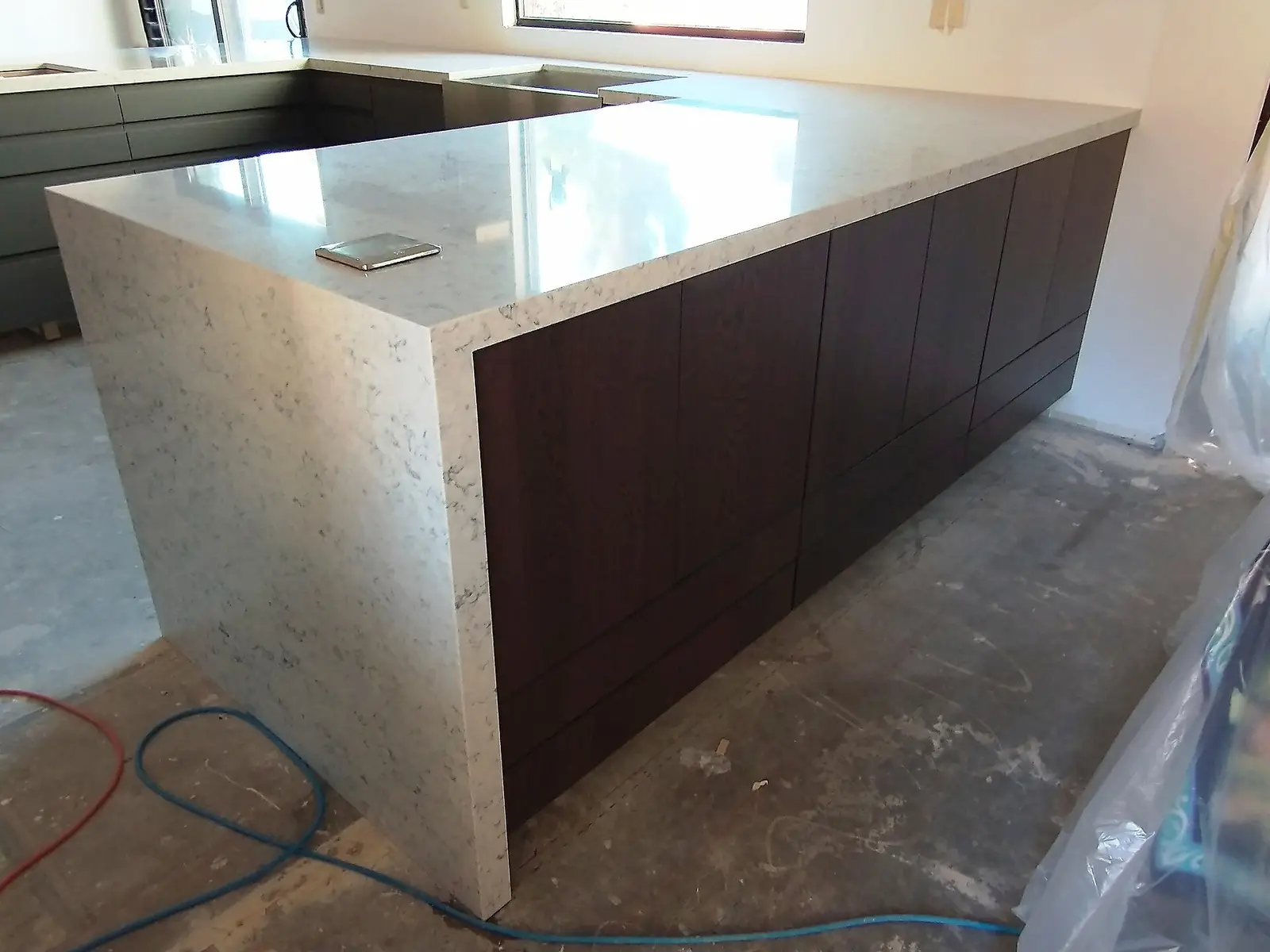
A kitchen island with a quartz waterfall countertop over dark cabinets, during a remodel. Photo: Stilfehler, CC BY-SA 4.0, via Wikimedia Commons.
CSLB license class
C-6 Cabinet, Millwork and Finish Carpentry, C-54 Ceramic and Mosaic Tile, C-61/D-12 Synthetic Products
Where it applies
San Francisco, East Bay, South Bay
Request
Free, up to three local pros reply
Cabinet and countertop jobs on Bay Area homes
Refacing cabinets instead of replacing them
Refacing keeps the existing cabinet boxes and replaces what you see: doors, drawer fronts and the face frames or veneer over them. Because the sink, drain and outlets stay where they are, it avoids most of the trade work that a full replacement drags in. Making and fitting new doors and trim is the finish carpentry CSLB assigns to the C-6 class, while swapping pulls or adjusting a sagging door is small repair work.
Replacing base and wall cabinets
When base cabinets come out, the countertop, sink, faucet, dishwasher and often the cooktop come out with them, and that is where other trades and permits enter. Reconnecting a drain or moving a supply line is plumbing, and adding or relocating outlets is electrical, and cities that need no permit for the cabinets can still require one for those. CSLB's C-6 class covers building and setting the cabinets themselves, including nonbearing partitions such as a pantry wall.
Quartz countertops
What is sold as a quartz countertop is, in Cal/OSHA's words, artificial stone, also called engineered stone. When it contains more than 0.1 percent crystalline silica by weight, cutting, drilling, grinding or polishing it is a high-exposure trigger task under California's silica standard, whatever the measured dust level. Setting the finished slab on the cabinets is C-54 work. Before choosing a slab, ask the fabricator how their shop follows those rules.
Granite, marble and other natural stone
A quarried slab is not automatically outside the silica rules. Cal/OSHA treats cutting, grinding and polishing of natural stone that contains more than 10 percent crystalline silica by weight as a high-exposure trigger task, the same category as engineered stone. CSLB's C-54 definition names natural or simulated stone slabs for horizontal surfaces inside buildings, which is where a stone counter sits, so the same license class covers granite, marble and quartz tops.
Laminate, solid-surface and epoxy tops
Not every counter is stone. CSLB's D-12 Synthetic Products limited specialty covers synthetic countertops and wall coverings, fiberglass, plastic, vinyl and epoxy products, and resin and epoxy application, so a contractor holding it can install a synthetic top or apply an epoxy coating over an old one. Ask for the product data sheet if a synthetic top is sold as a stone look-alike: California's high-exposure silica rules turn on crystalline silica content, not on what the material is called.
The license this work needs
C-6 Cabinet, Millwork and Finish Carpentry
C-54 Ceramic and Mosaic Tile
C-61/D-12 Synthetic Products
CSLB's C-6 class covers making and installing cabinets, doors, trim and nonbearing partitions. Natural or simulated stone slabs on horizontal surfaces inside a building fall under C-54 Ceramic and Mosaic Tile, and synthetic countertops under the D-12 Synthetic Products limited specialty. Tightening a hinge or replacing a drawer front is handyman work; a full cabinet and counter job usually runs past the state's small-job limit and belongs with a licensed contractor in the right class. Check the number at cslb.ca.gov.
Cal/OSHA's general silica standard, Title 8 section 5204, excludes construction work covered by the separate construction silica standard, section 1532.3. A fabricator's shop is regulated under section 5204, which also steps aside for an occasional task that is indistinguishable from a listed construction task when the employer follows the construction standard. Cutting a sink or cooktop opening indoors still makes dust in your house, so ask where each cut will be made.
Old paint on original cabinets
Built-in cabinets, shelves and trim in a Bay Area house built before 1978 may carry lead-based paint under later coats. Tearing them out is renovation under the EPA's Renovation, Repair and Painting rule, so the company doing it has to be an EPA or state recognized RRP firm, with renovators trained to keep dust contained. Settle that before demolition day, because containment has to be set up before the first cabinet comes off the wall.
Kitchen circuits behind the backsplash
A new counter often exposes wiring that no longer meets code. Contra Costa County's permit handout, written to the 2022 California Electrical Code, lists what it expects: GFCI and AFCI protection and tamper-resistant receptacles, an outlet at every counter space 12 inches or wider, no point along the wall more than 24 inches from an outlet, and at least two 20-amp circuits for the counters. When the existing panel cannot support that, it may need an upgrade or a sub-panel.
San Francisco's lead rules reach inside rented flats. The city presumes every building finished before 1979 contains lead-based paint, and its Building Code requires lead-safe work practices in the interior of pre-1979 residential rental property and child care space, as well as on the outside of any pre-1979 building. Replacing painted cabinets in a rented unit brings those local rules on top of the federal ones, including notice to residential occupants at least three days ahead.
In unincorporated Contra Costa County, work that includes replacing kitchen countertops needs a building permit, obtained before the work starts, while new upper cabinets or cabinet refacing need none. Inspectors want a rough electrical inspection after new electrical boxes are installed and before devices are connected, then a final inspection when everything is done. That differs from Berkeley, which lists cabinets and counter tops among finish work exempt from building permits.
Milpitas lists cabinets and counter tops as finish work that needs no building permit, but its building office spells out that electrical and plumbing permits are still required to install, replace or relocate outlets, wiring and panels, or plumbing fixtures such as sinks. A new counter that arrives with a new sink or added outlets therefore needs trade permits even though the counter itself does not. Ask the installer who pulls them.
Permits and rules to know
Cal/OSHA section 5204 for stone fabricators
California's silica standard was changed by an emergency update in December 2023 and by permanent amendments effective February 5, 2025. For high-exposure trigger tasks on artificial stone or high-silica natural stone, it applies regardless of exposure levels or test data, requires effective wet methods, and prohibits any use of compressed air on silica-containing materials and any dry sweeping, shoveling or other dry clean-up of the waste. These are duties of the fabricator as an employer.
The finish-work permit exemption
Berkeley's list of work exempt from building permits includes painting, papering, tiling, carpeting, cabinets, counter tops and similar finish work, wording other California building departments use as well. The city adds that exempt work must still meet the California Building Standards Code and Berkeley's own ordinances. The exemption covers the cabinets and counters, not the plumbing and electrical connections that come with them, so check those separately with your building department.
Before you hire
Ask the fabricator how their shop meets Cal/OSHA section 5204: wet cutting, no compressed air and no dry sweeping.
Ask which license covers each part: C-6 for cabinets, C-54 for stone slabs, D-12 for synthetic tops.
Ask who disconnects and reconnects the sink, dishwasher and cooktop, and whether that part needs its own permit.
For a house built before 1978, ask for the firm's EPA lead renovation (RRP) credentials before painted cabinets come out.
Ask whether any sink or cooktop openings will be cut inside your house, and how that dust will be controlled.
Ask whether your city or county requires a permit for new counters, and who applies for it.
Before crews start carrying slabs through the house, ask for proof of workers' compensation coverage and a liability insurance certificate.
How a request works
Describe the job
A few sentences and a photo of the problem or the space. It takes about a minute.
Local pros get in touch
Up to three handymen or contractors who take this kind of work may call or text to ask questions and quote.
Check, compare, decide
Look up the license, compare what you hear, and agree the scope and price with the one you pick. Requesting costs nothing.
Questions about cabinet and countertop work in the Bay Area
Is a quartz countertop the same thing as engineered stone?
For California's worker-safety rules, yes. Cal/OSHA's silica standard describes artificial stone as also called engineered stone or quartz, and products with more than 0.1 percent crystalline silica by weight trigger its strictest protections when they are cut, ground or polished. Those rules protect the people who fabricate the slab, so ask the fabricator how their shop complies.
Is granite treated differently from quartz under the silica rules?
Not necessarily. Natural stone with more than 10 percent crystalline silica by weight falls in the same high-exposure category as engineered stone above 0.1 percent, which means wet methods and no dry clean-up during fabrication. The threshold differs, the protections do not, so a granite fabricator should be able to explain the same dust controls.
Will a permit for new counters in Contra Costa County make us replace the kitchen faucet?
It can. The county applies the CALGreen rule that non-compliant plumbing fixtures throughout the house be upgraded whenever a permit is issued for an alteration or improvement, and a kitchen faucet flowing more than 2.2 gallons per minute is on that list. Houses built after January 1, 1994 are exempt from the requirement.
Can a handyman install our new kitchen cabinets?
A handyman can adjust hinges, swap doors and pulls, or rebuild a drawer. Installing a full set of cabinets and counters normally runs past what California allows without a contractor's license, and it belongs with a licensed contractor in the right class: C-6 for the cabinets and C-54 for stone slabs, with plumbing and electrical connections handled by those trades.
Who can install a laminate or solid-surface countertop?
CSLB's D-12 Synthetic Products classification, a limited specialty under C-61, covers synthetic countertops and wall coverings along with resin and epoxy application. A C-6 cabinet contractor sets the cabinets underneath, and some jobs use both. Check each license number and its classifications at cslb.ca.gov before signing.
Checked against these public sources in September 2026. Codes and programs change: confirm permit rules with your city's building department and a license on the CSLB website before work starts.