Old supply pipe, sewer laterals and gas lines on Bay Area houses
The large plumbing jobs on a Bay Area house are the ones buried in walls and yards: galvanized supply pipe, the sewer lateral out to the street, and gas piping from the meter. Local rules shape them. In eight East Bay communities a lateral has to pass an air or water test before a sale closes, and in San Francisco the owner answers for the lateral up to the curb.
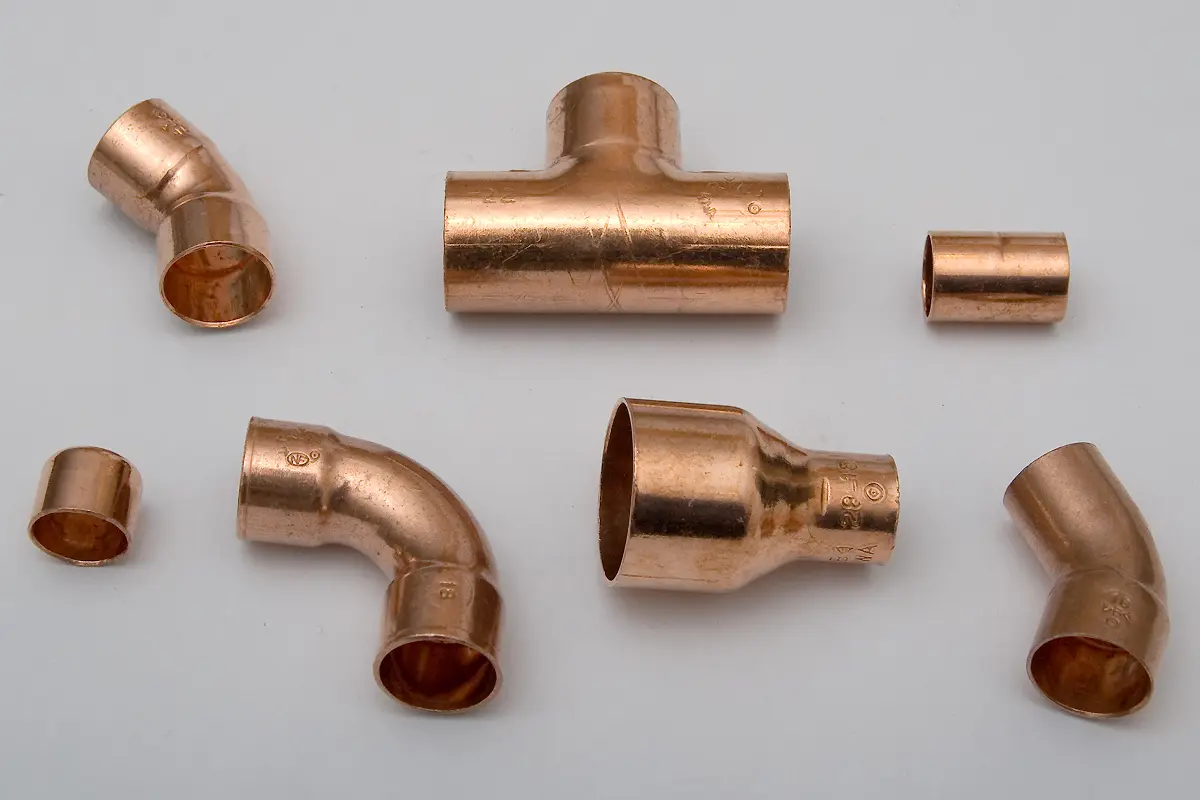
Copper pipe fittings: elbows, a tee, reducers and couplings. Photo: Torsten Bätge, CC BY-SA 3.0, via Wikimedia Commons.
CSLB license class
C-36 Plumbing, C-42 Sanitation System
Where it applies
San Francisco, East Bay, South Bay
Request
Free, up to three local pros reply
Plumbing jobs on Bay Area homes
Replacing galvanized supply pipe
Older houses were often plumbed in galvanized steel, which rusts from the inside until the bore narrows and a shower loses pressure whenever another tap opens. A repipe replaces the supply lines from the main shutoff to each fixture and means opening walls and ceilings along the route, which in a plaster house is a real part of the job. San Francisco requires a plumbing permit before pipes are cut into or replaced, and the new pipe has to be inspected before the walls are closed.
Sewer lateral repair and replacement
The lateral is the pipe that carries everything from the house's drains to the public sewer main under the street. When it cracks, separates or blocks, the signs are slow drains on the lowest floor and backups after rain. A contractor runs a camera through it from a cleanout, then either repairs a section, replaces the whole run by trench, or proposes another method. The San Francisco Public Utilities Commission advises having a licensed professional inspect a lateral at least once every five years.
Gas piping for moved or new appliances
Moving a range, adding a gas dryer line or rerouting piping during a remodel is C-36 work that runs from the meter through the house to each appliance. The work also runs the other way now. The Air District's zero-NOx standards reach new residential tank water heaters in 2027 and furnaces in 2029 under the current schedule, and zero-NOx equipment today is electric, so a gas branch left unused after a switch is a job for a plumber too.
Main shutoffs, pressure regulators and expansion tanks
Many old houses have a main shutoff that has not been turned in decades and no longer closes fully, which matters most in an earthquake or a burst pipe. Replacing it, or adding a pressure regulating valve where street pressure runs high, is routine plumbing work. A regulator changes the system: it creates what the plumbing code calls a closed system, and San Jose's permit guidance states that a closed system, such as a house with a pressure reducing valve, must have an expansion tank.
Backwater valves on low lots
A backwater valve on the building sewer lets waste flow out but closes when the public sewer surcharges, so sewage cannot rise out of a basement shower or floor drain during a storm. It is most useful on houses whose lowest fixtures sit below the street. The SFPUC points San Francisco owners to the Department of Building Inspection's Plumbing Division for installation guidance, and flooding from the sewer system can make a property eligible for its Floodwater Grant program.
The water service line from the meter
The pipe between the water meter at the curb and the house belongs to the owner, and on older lots it can still be galvanized. Replacing it means a trench from the meter box to the foundation and a new connection at the main shutoff. In San Francisco the SFPUC has been replacing its own galvanized service lines on the utility side of the meter with copper, and it recommends owners replace galvanized lines on their side that may once have been connected to lead pipe.
The license this work needs
C-36 Plumbing
C-42 Sanitation System
CSLB's C-36 Plumbing class covers water and gas piping from the utility meter to the house, waste lines, water heaters, and safety devices such as earthquake valves, backflow preventers and pressure regulating valves. C-42 Sanitation System covers sewage and storm drain structures. A faucet or toilet swap is handyman work; a repipe, a new gas branch or a lateral replacement needs a permit and a licensed contractor. Look up the license number at cslb.ca.gov before you sign.
A lateral has an upper section, from the building to the curb, and a lower section, from the curb to the main. In San Francisco the whole lateral belongs to the property owner, but under most circumstances the SFPUC repairs the lower section once a plumber's inspection finds a problem there and the owner reports it through 311. In the East Bay communities under EBMUD's regional ordinance, the owner is responsible for both sections, except in Alameda and Albany, where responsibility ends at the property line or the curbside cleanout.
Winter rain getting into the sewer
A cracked or open-jointed lateral does not only leak out. When winter storms soak the ground, groundwater and rain seep in through the same gaps, and that extra flow is exactly what the East Bay's lateral program aims to keep out, to cut the untreated and partly treated wastewater that reaches the Bay. That is why EBMUD's program measures a lateral with an air pressure test or a water exfiltration test rather than a visual look, and why a lateral that drains fine in summer can still fail one.
Houses that no longer match their permits
A century-old house has usually been replumbed in pieces: a bathroom in one decade, a kitchen in another, a basement laundry added by an owner. The result is a mix of galvanized, copper and plastic joined wherever the last job stopped. A contractor pricing a repipe or a lateral should expect surprises inside walls and under floors, and Oakland's permit rules draw a useful line: fixing a leak in a drain or vent pipe or clearing a clog needs no permit, but installing, changing or replacing piping does.
San Francisco's upper lateral is more than a pipe. The SFPUC notes it includes a trap and a vertical sewer vent, sometimes called a fresh air inlet, that rises to the sidewalk, and both are the owner's to maintain. The SFPUC also keeps a lookup map at sfpuc.gov/Lead showing addresses with galvanized service lines, and as of January 2026 it had identified 699 customer-owned galvanized lines it recommends replacing.
EBMUD's private sewer lateral rules apply in Alameda, Albany, Emeryville, Oakland, Piedmont, El Cerrito, Kensington and the Richmond Annex. EBMUD says most agencies in its wastewater area require a permit to work on a lateral, and Emeryville requires one even when the lateral is only being tested as it is. In Oakland, a permit is issued as soon as the application is submitted and paid when the work needs no plan review.
Well water changes the plumbing here. Santa Clara Valley Water reports that groundwater in the county averages over 250 mg/L of hardness, against under 120 mg/L for its treated surface water, and warns that hard water builds scale in pipes and fixtures that can lower water pressure. San Jose Water draws part of its supply from wells, so pressure loss in an old house may be scale as well as corrosion.
Permits and rules to know
San Francisco plumbing permits
San Francisco requires a permit before anyone cuts into or replaces pipes carrying water, gas, hot air or cool air, especially pipes that will be covered by a wall or buried, with exemptions listed in San Francisco Plumbing Code Section 104.2. Permits are applied for online through PermitSF. A C-4 or C-36 contractor can pull a plumbing permit, and a B contractor after approval of the scope. Only owners of stand-alone single-family houses may take one out to do the work themselves.
San Francisco Public Works side sewer permit
Lateral work that crosses into the sidewalk or street needs a Side Sewer permit from San Francisco Public Works, covering work past the trap toward the roadway and up to the sewer main. Only a contractor holding a Class A license, a C-36 together with a C-12, or a C-42 can get one. Public Works also requires a street excavation bond, a call to Underground Service Alert (811) 72 hours before digging, and scheduling the inspection at least 10 days ahead.
EBMUD Regional Private Sewer Lateral Ordinance
In the eight communities covered by EBMUD's regional ordinance, a lateral needs a Compliance Certificate showing it is free of leaks when one of three things happens: the property is bought or sold, the owner builds or remodels above the ordinance's valuation threshold, or the size of the water meter changes. The certificate is required to close escrow on a sale, or for final sign-off on the building permit. Passing takes an air pressure or water exfiltration test, which the contractor sets up for verification once any repair is done.
Before you hire
Ask for the camera inspection video of the lateral, not only a written summary of what it showed.
For lateral work in a San Francisco sidewalk or street, confirm the contractor holds an A license, a C-42, or a C-36 with a C-12.
Ask which walls and ceilings a repipe will open, and whether patching the plaster or drywall is in the price or left to you.
Check that the plumbing permit will be pulled under the contractor's own license number, not in the homeowner's name.
Selling in an EBMUD ordinance community? Ask whether the quote includes the air or water test and the Compliance Certificate paperwork.
Look up the license at cslb.ca.gov and confirm it lists C-36 Plumbing or C-42 Sanitation System.
Ask for proof of workers' compensation coverage for everyone who will dig or work in a trench on your lot.
How a request works
Describe the job
A few sentences and a photo of the problem or the space. It takes about a minute.
Local pros get in touch
Up to three handymen or contractors who take this kind of work may call or text to ask questions and quote.
Check, compare, decide
Look up the license, compare what you hear, and agree the scope and price with the one you pick. Requesting costs nothing.
Questions about plumbing work in the Bay Area
Who pays to fix the sewer pipe under the street in San Francisco?
The owner owns the whole lateral, but the SFPUC handles the lower section, from the curb to the main, under most circumstances. Have a licensed plumber inspect it, and if the problem is in the lower lateral and cannot be fixed with maintenance, submit a service request through 311 or sf311.org. The upper section, from the house to the curb, is the owner's to repair to current San Francisco plumbing code.
Do I need to replace my sewer lateral before selling a house in Oakland?
Not necessarily replace it, but it has to pass. Oakland is one of the communities under EBMUD's Regional Private Sewer Lateral Ordinance, and a sale is one of its triggers. A Compliance Certificate is required to close escrow, showing showing the lateral does not leak, which means an air or water test. If the lateral fails, it is repaired or replaced and tested again.
Is galvanized pipe a lead concern in San Francisco?
The SFPUC says its plumbers have never found a customer-owned lead service line, but it recommends replacing customer-owned galvanized service lines because they may once have been connected to lead pipe, and those customers may request a lead test. Its lookup map at sfpuc.gov/Lead shows which addresses are on its list.
Can the handyman who replaced my faucet also move my gas line?
No. Swapping a faucet or a toilet on existing connections is handyman work, but gas piping falls under CSLB's C-36 Plumbing class and needs a permit in cities such as San Francisco and Oakland. Ask a C-36 contractor to quote it and to take out the permit, so the new piping is inspected before it is covered.
Why does my plumber say I need an expansion tank?
Usually because the house has, or is getting, a pressure reducing valve on the water service. With one in place, water heated in the tank has nowhere to expand back into the street main. San Jose's permit guidance states plainly that a closed system of that kind must have an expansion tank installed.
How often should a sewer lateral be checked?
The SFPUC recommends having a licensed plumber or contractor inspect the lateral at least once every five years, and sooner if drains on the lowest floor slow down or back up in wet weather. Keeping grease, wipes and anything but toilet paper out of the drains protects it between inspections.
Checked against these public sources in September 2026. Codes and programs change: confirm permit rules with your city's building department and a license on the CSLB website before work starts.