Clearing Bay Area gutters, from spring oak drop to ember weather
Gutter cleaning in the Bay Area does two jobs. Before the winter storms it keeps roof water moving into downspouts instead of over the fascia. In fire country it is also upkeep the law expects: in a state responsibility area, and in a Very High Fire Hazard Severity Zone a city has designated, California requires the roof of a home to be kept free of leaves, needles and other vegetation, and leaf-filled gutters are where embers catch.
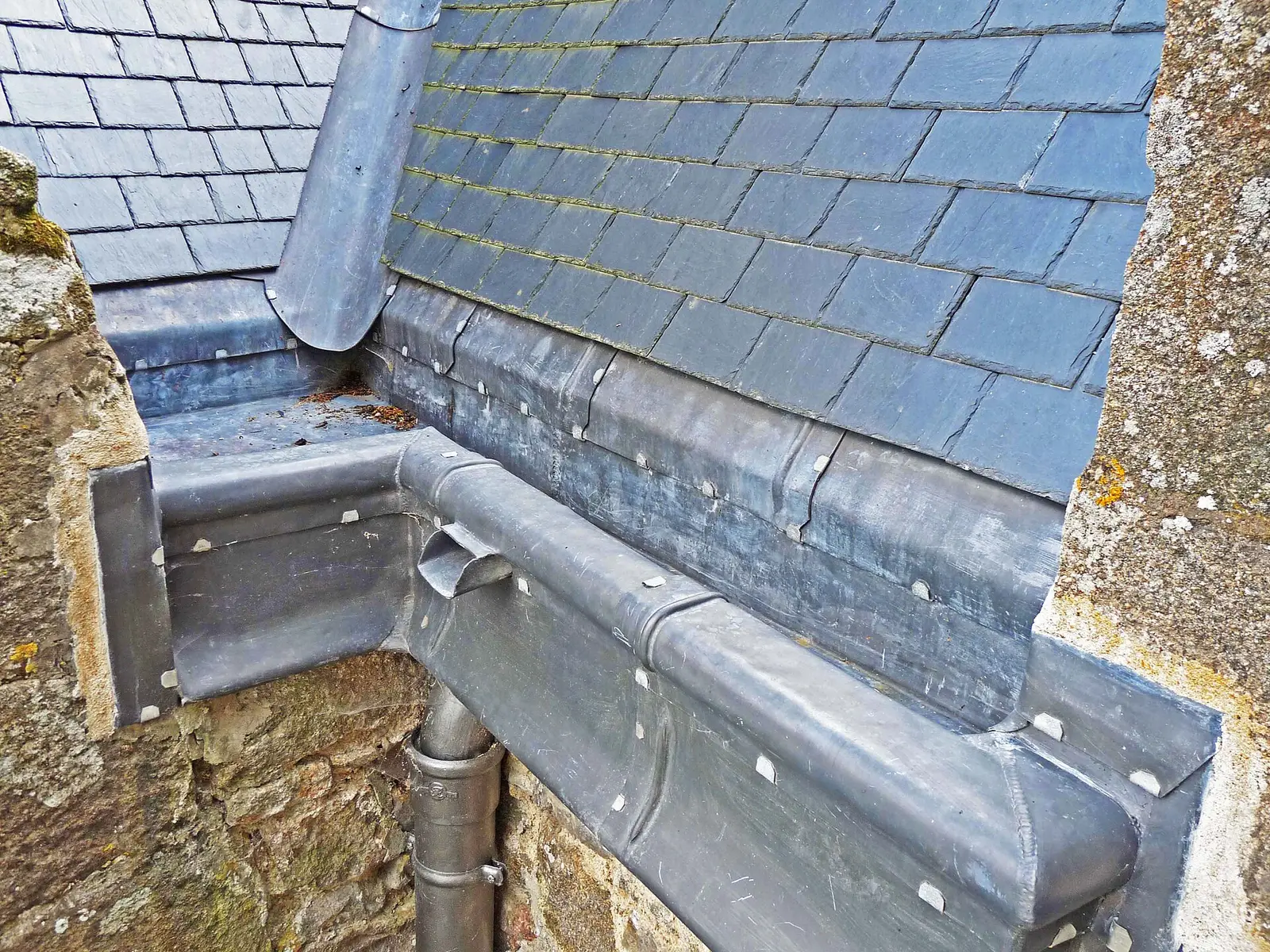
Metal roof gutter running along the bottom of a slate roof, with a downspout outlet dropping into a round drainpipe. Photo: Le plombier du désert, CC BY-SA 3.0, via Wikimedia Commons.
CSLB license class
C-43 Sheet Metal, C-39 Roofing, D-49 Tree Service
Where it applies
San Francisco, Peninsula, South Bay, East Bay, North Bay
Request
Free, up to five local pros reply
Gutter cleaning jobs on Bay Area homes
Clearing troughs, valleys and downspouts
A full clean-out covers more than the trough. Leaves and needles pile up in roof valleys and behind chimneys before they ever reach a gutter, and downspouts clog at the elbows where they turn toward the ground. FIRESafe MARIN notes that combustible debris builds up fastest under nearby or overhanging trees, and that upper-story gutters get cleaned least because they are hard to reach. Ask for the downspouts to be run with water at the end, so a blockage shows up on a dry day rather than in the first storm.
Fitting or servicing gutter guards
Guards and covers cut down how much litter lands in the trough, but FIRESafe MARIN lists three catches. Some products work loose over time and have to be reattached. Some let debris collect on the roof just behind the gutter, where it still needs clearing. And there is no standard test procedure yet for judging how well any of them perform. A guard reduces cleaning; it does not end it, so a visit to a guarded gutter should include checking the fastening and the roof edge above it.
Hooking a downspout to a rain barrel
Bay Area water agencies that pay rebates on rain barrels set similar installation terms. San Francisco's program, for example, wants the barrel and a diverter connected to a downspout, compliance with Chapter 16 of the California Plumbing Code, a mosquito-proof screen with mesh under one millimeter or a tight lid, and an overflow that sends excess water away from the house and the neighbors. Cutting a downspout for a diverter is small work, but check the rebate's rules before the cut, because some programs want approval first.
Replacing a run of gutter
When a section has rusted through or pulled away from the fascia, replacement is C-43 work once it passes the $1,000 line. In fire hazard areas, material matters. FIRESafe MARIN recommends metal over vinyl: embers ignite debris in either, but a burning vinyl gutter detaches and falls, setting mulch, plants and siding below alight, while a metal gutter stays up and burns at the roof edge. On new buildings in fire hazard zones, the 2025 wildfire code now requires noncombustible gutters and downspouts.
Rot at the roof edge behind the gutter
Cleaning is often when rot behind a gutter shows up. FIRESafe MARIN's gutter guidance describes decayed roof deck boards in an eave overhang, which would be easily ignited if debris in the gutter caught fire, and recommends metal flashing at the roof edge because it protects the fascia and sheathing that a burning gutter exposes. Soft fascia boards are carpentry; damaged roof sheathing or flashing belongs to a roofer. Either way it is worth knowing before new gutters are hung on old wood.
Branches over the roof
Overhanging limbs are where most gutter debris comes from, and California's defensible space laws reach them too: in the areas they cover, a tree or shrub next to or overhanging a building must be kept free of dead or dying wood, and any part of a tree within 10 feet of a chimney or stovepipe outlet must be removed. A street tree in the planting strip may belong to the city, which can require a permit before anyone prunes it. Tree work past the small-job line needs a D-49 tree service.
The license this work needs
C-43 Sheet Metal
C-39 Roofing
D-49 Tree Service
Scooping leaves out of a gutter and flushing a downspout is upkeep. Small fixes, such as resealing a leaking joint or refastening a loose hanger, stay handyman work while the whole job is under $1,000 in labor and materials and needs no permit. Installing or replacing gutters above that is sheet metal work: the CSLB's C-43 class names gutters and leaders, the trade word for downspouts. Damaged roofing behind the gutter belongs to a C-39 roofer, and cutting back limbs over the roof to a D-49 tree service. Check any license number at cslb.ca.gov.
Gutters under oaks fill on a different calendar. The coast live oak, native mostly to the coast side of California's Coast Range, is evergreen, yet it drops most of its old leaves in spring as new ones come in. Under sycamores, maples and other deciduous trees the load arrives in autumn instead. A house with both can need a spring clean-out as well as the usual one before the rains, and a spring clean-out also leaves the gutters empty going into the dry months of fire season.
Embers land where leaves collect
Wind-blown embers drift into the same places leaves do. FIRESafe MARIN explains that burning leaves in a gutter can spread fire into the house, particularly where flashing between the gutter and the roof line is missing or inadequate, and that ignited gutter debris exposes the roof's edge, usually the fascia and sheathing. Its standing advice for homes in fire hazard areas is that gutters be kept completely free of leaves, needles and vegetation through fire season, and cleaned more often in summer where leaves keep falling.
Standing water and mosquitoes
A gutter that holds water after a storm is a breeding site. The San Mateo County Mosquito and Vector Control District asks residents to clean rain gutters clogged with leaves and to empty standing water at least once a week, because mosquitoes can lay eggs in very small amounts of it. The fix is usually a level problem or a blocked outlet rather than the gutter itself: re-pitching a sagging section so water runs to the downspout, or clearing the outlet.
San Francisco is the only coastal city in California with a combined sewer, which carries rainwater and household wastewater in the same pipes. Its utility says stormwater enters that system through building roof drains and street catch basins and is treated at its plants before discharge to the Bay or Ocean. A downspout here usually feeds the sewer, and capturing roof water in a rebate-eligible barrel or cistern takes load off it during storms.
San Mateo County's countywide rain barrel rebate, funded by the Flows To Bay stormwater program and run by the Bay Area Water Supply and Conservation Agency, requires the barrel to be fed by a rain gutter downspout, a rain chain or another way of capturing concentrated roof flow. It does not allow copper materials, downspouts included, because of leaching concerns, so a house with copper downspouts needs a different connection to qualify.
Valley Water, the Santa Clara County water district, offers help to owners who already have gutters or downspouts that are not capturing rainwater, with rebates for rain barrels, cisterns and rain gardens under its landscape program. The site needs a pre-inspection and an approved online application before any work starts, so a downspout should not be cut for a barrel until approval comes through.
Berkeley's Home Hardening Mesh Program gives free metal mesh to residents of the Grizzly Peak and Panoramic Mitigation Areas and the Very High Fire Hazard Severity Zones, to fit over vents, under decks and on top of gutters, where the city says it keeps leaves and debris from building up and catching fire. Residents apply online, choose the mesh size and install it or have it installed.
FIRESafe MARIN strongly discourages foam gutter inserts, even ones marketed as fire-resistant. In its informal testing the foam was highly combustible, ignited easily and spread fire rapidly, and it says it has asked the State Fire Marshal and the Consumer Product Safety Commission for help removing the products from the market. Owners in Marin's wildland-urban interface who have foam inserts can ask for them to be pulled out at the next cleaning.
Permits and rules to know
Roofs kept clear in fire hazard areas
Two parallel state laws carry the same roof rule. Public Resources Code 4291 covers buildings in the state responsibility area, and Government Code 51182 covers occupied homes in a Very High Fire Hazard Severity Zone designated by a city or county. Both require the owner to keep the roof free of leaves, needles and other vegetative materials, to keep plants next to or over the building free of dead or dying wood, and to cut back any part of a tree within 10 feet of a chimney outlet.
Gutters on new homes in fire hazard zones
Since January 1, 2026, California's wildfire construction rules sit in their own code, the 2025 California Wildland-Urban Interface Code, Title 24, Part 7.5. Its Section 504.4 requires gutters and downspouts of noncombustible material, and requires gutters to have an approved means of keeping leaves and debris from accumulating in them. The 2022 Building Code's Chapter 7A, which it replaced, already required that debris protection but not the material. These rules govern new construction; existing gutters are not forced to change.
Before you hire
Ask whether the quote covers roof valleys and the roof behind any gutter guard, not only the troughs.
Ask where the debris goes: your green cart, their truck, or a pile for a city pickup where your city allows one.
Ask that downspouts be flushed onto landscaping or into a barrel, never rinsed down the driveway to a storm drain.
If they recommend gutter guards, ask which type and how they are fastened; FIRESafe MARIN warns against foam inserts.
On a two-story house, ask how the ladder will be footed and kept clear of the overhead service wires.
If a run needs replacing, check the installer's C-43 license number at cslb.ca.gov before paying a deposit.
Ask for proof of workers' compensation coverage before anyone goes up on your roof.
How a request works
Describe the job
A few sentences and a photo of the problem or the space. It takes about a minute.
Local pros get in touch
Up to five handymen or contractors who take this kind of work may call or text to ask questions and quote.
Check, compare, decide
Look up the license, compare what you hear, and agree the scope and price with the one you pick. Requesting costs nothing.
Questions about gutter cleaning work in the Bay Area
Is keeping gutters clean actually required where I live?
In fire country, effectively yes. Public Resources Code 4291, for the state responsibility area, and Government Code 51182, for Very High Fire Hazard Severity Zones a city or county has designated, both require the roof to be kept free of leaves, needles and other vegetation. FIRESafe MARIN goes further and tells owners to keep gutters completely clear through fire season. Outside those zones it is ordinary upkeep, though clogged gutters still spill onto fascia and foundations every winter.
We have oaks over the house. Why are the gutters full again in April?
Because coast live oaks shed on their own schedule. They are evergreen, but they drop most of their old leaves in spring as new growth comes in, so a gutter that was cleared before the rains can be full again by April or May. Under oaks, a spring clean-out is normal, and it has the side benefit of emptying the gutters before the dry fire season.
Are gutter guards worth installing?
They help, with limits. FIRESafe MARIN says properly installed and maintained guards reduce the litter that reaches the gutter, but some come loose, some trap debris on the roof behind them, and no standard test yet rates them. It strongly discourages foam inserts. In Berkeley's highest-risk hill areas the city gives residents free metal mesh for the tops of gutters.
Should replacement gutters be metal or vinyl?
In a fire hazard area, metal. FIRESafe MARIN explains that embers ignite debris in any gutter, but vinyl gutters quickly detach and fall while burning, spreading fire to whatever is below. New buildings in fire hazard zones must now have noncombustible gutters and downspouts under Section 504.4 of the 2025 California Wildland-Urban Interface Code.
Can the gutter debris go in my green cart?
Leaves can. Bay Area haulers take leaves and small trimmings in the green or organics cart, but each sets its own branch-size limit, and some refuse palm fronds outright: Recology San Mateo County caps branches at 4 inches across, and Recology South Valley in Gilroy at 6. Check your hauler's list before a big clean-out fills the cart with the wrong things.
Checked against these public sources in October 2026. Codes and programs change: confirm permit rules with your city's building department and a license on the CSLB website before work starts.