Plumbing Castro Valley

Castro Valley plumbing under a sanitary district's sale rule

Before a Castro Valley house can close escrow, its sewer lateral needs a compliance certificate from the Castro Valley Sanitary District, earned on a camera inspection a district inspector watches. The district's list of acceptable lateral pipe is short, and a lateral of Orangeburg, ABS or PVC has to be replaced. Building permits come from Alameda County, water from EBMUD, and two neighborhoods sewer to Oro Loma instead.

  • Free to request, no obligation to hire
  • Up to five local pros who take this work can reply
  • Rules on this page checked against 11 public sources, October 2026
Houses on the hills of west Castro Valley
Houses on the hills of west Castro Valley. Photo: Lights and freedom, CC BY-SA 4.0, via Wikimedia Commons.
Lateral ordinance
CVSan Ordinance No. 179, applied to sales since July 1, 2019
Camera reviews, 2019-2023
359 of 641 laterals passed CVSan's review
Building permits
Alameda County Public Works Agency, 399 Elmhurst Street, Hayward
Sewered by Oro Loma
Hillcrest Knolls and El Portal Ridge

Permits and local rules

District, county and Oro Loma rules a bid has to cover

  1. CVSan Ordinance No. 179

    CVSan's board adopted its Private Sewer Lateral Ordinance on September 4, 2018, and since July 1, 2019 every commercial, industrial and residential property sold inside the district must have a Sewer Lateral Compliance Certificate before escrow closes. Exceptions include a valid certificate already on file, a lateral built or fully replaced within 30 years of the sale and documented by a district permit, a foreclosure transfer to a bank and an inter-family transfer.

    Castro Valley Sanitary District (opens in a new tab)
  2. Where the owner's pipe begins and ends

    CVSan defines the private lateral as the pipe from its junction with the building plumbing, usually within two feet of the foundation wall, to and including the connection to the public sewer main. It is the owner's property, and the owner bears every cost of installing, maintaining, repairing, altering or abandoning it. The district counts these laterals among the main sources of rainwater and groundwater entering its system and causing overflows.

    Castro Valley Sanitary District (opens in a new tab)
  3. Oro Loma Ordinance 35-17

    In the parts of Castro Valley that Oro Loma Sanitary District sewers, sales entering escrow on or after August 1, 2026 need a Sewer Lateral Compliance Certificate before title transfers. Oro Loma's inspection is stricter in one respect: a camera run and an air or water pressure test, both with a district representative present. Large additions, new ADUs and repairs made without a district permit also trigger an inspection, and certificates run up to 10 years, or 20 after full replacement.

    Oro Loma Sanitary District (opens in a new tab)
  4. Alameda County plumbing permit exemptions

    The county's Work Exempt From Permit guideline for the 2025 California codes, effective January 1, 2026, applies to unincorporated communities such as Castro Valley. Its plumbing exemptions cover stopping leaks in drain, waste or vent pipe and clearing stoppages. Once a defective trap or drain has to be replaced with new material, the county treats it as new work that needs a permit and an inspection.

    Alameda County Public Works Agency (opens in a new tab)

State license for this work: C-36 Plumbing, C-42 Sanitation System. Look up a contractor's license on the CSLB website (opens in a new tab).

Free request

Describe the plumbing job once. Local pros who take work in Castro Valley reply by call or text.

  • No fee to request, and no obligation to hire
  • You agree scope and price with the pro you choose
  • Photos help them quote without a first visit

Get quotes for plumbing work in Castro Valley

Two short steps. A local pro who takes this work calls or texts you back.

To send a request, call or text (415) 449-8213.

Free to request, and you agree the scope and price with the person you hire before work starts. In California, a job over $1,000 in labor and materials, or one that needs a building permit, must be done by a contractor licensed by the CSLB in the right class. Ask for the license number and check it at cslb.ca.gov.

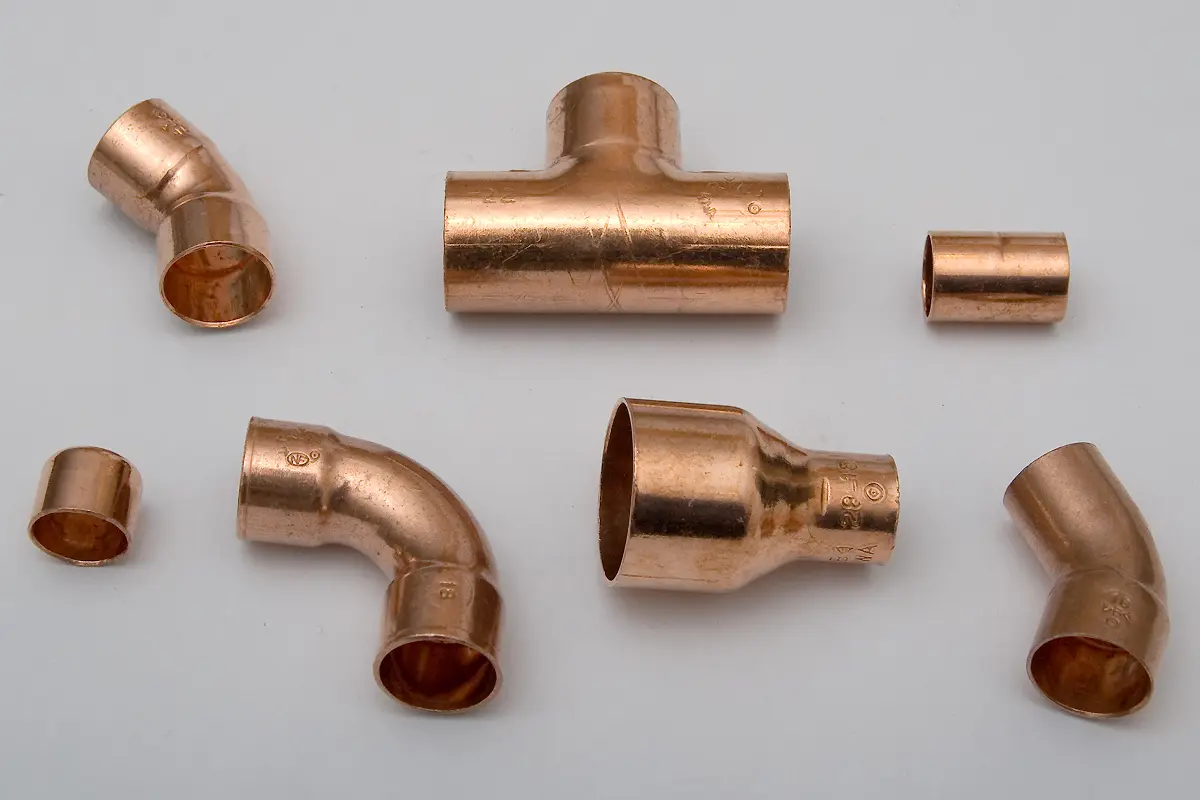
Copper pipe fittings: elbows, a tee, reducers and couplings
Copper pipe fittings: elbows, a tee, reducers and couplings. Photo: Torsten Bätge, CC BY-SA 3.0, via Wikimedia Commons.

The houses here

Post-war sewer pipe and the year 1960

Much of the valley floor filled in after the war, which matters underground. CVSan describes Orangeburg pipe as pressed layers of wood pulp and pitch that deform under long pressure, and says its widespread use began during World War II, when cast iron was short. Roots get in, and a rooter cleaning them out tears the pipe apart. The district's inspection data points the same way: the more recently a building went up, the likelier its lateral passes, and CVSan encourages owners of houses built after 1960 to try the camera first. The Greenridge Eichlers, built from 1960 to 1965, sit right at that line.

Part by part

Where the sewer, or the lack of one, changes the job

  • Hillcrest Knolls and El Portal Ridge

    The 2012 Castro Valley General Plan names these two neighborhoods as the ones Oro Loma, not CVSan, sewers. That puts them under Oro Loma's pressure-tested sale certificate, and under its standard requiring a backflow prevention system whenever a lateral is repaired or replaced.

  • Crow Canyon, Cull Canyon and Palomares Canyon

    The same plan lists the developed areas still relying entirely on private septic systems: off Crow Canyon Road beyond Cold Water Drive, off Cull Canyon Road and in Palomares Canyon. It also counted about 150 domestic well users in the planning area, the wells mostly along rural canyon roads, so a plumbing call there may start at a well and end at a septic tank rather than a lateral.

The work

What a Castro Valley sewer or water call usually becomes

  1. A witnessed camera run before a sale

    The contractor books a CVSan CCTV permit through the district's online portal or at its office on Marshall Street, then runs the camera while a district inspector watches. District staff review the video for offset joints, cracks, breaks, root intrusion, improper connections and pipe material. A pass earns a certificate good for ten years. The result itself expires six months after the review date, so testing far ahead of a listing can mean paying for it twice.

  2. Replacing a lateral the district will not accept

    CVSan's program page lists vitrified clay, cast iron, ductile iron and HDPE SDR 17 as approved lateral materials, and Orangeburg, ABS and PVC as non-approved, saying a lateral made of the last three will be required to be replaced. The district suggests having a sewer contractor identify the pipe before paying for a camera permit at all. A full replacement under a CVSan sewer repair permit earns a 30-year certificate once a district inspector signs it off.

  3. Spot repairs that still have to pass

    When the camera finds a defect in one section, the repair can be done before or after escrow closes, but the sewer contractor needs a CVSan sewer repair permit before touching the pipe. A partial repair earns a ten-year certificate, not the 30-year one. The same contractor does not have to do both jobs: CVSan says owners may hire someone else for the repair and recommends getting at least three estimates.

  4. A water heater swap under county rules

    Castro Valley has no city building department, so water heaters, repipes and gas lines are permitted by the county's Building Inspection Department. Its 2025 list of work exempt from permits names appliances such as dishwashers, ranges and dryers that can be swapped in place under conditions, but not water heaters, and its plumbing exemptions stop at clearing stoppages and stopping leaks without replacing pipe, valves or fixtures.

Before you hire

Questions for a plumber before the camera goes in

  • Ask what the lateral is made of before buying a CVSan camera permit; ABS, PVC or Orangeburg means replacement, not inspection.
  • Confirm whether your street sewers to CVSan or to Oro Loma, since the two districts test laterals differently.
  • Ask who will book the CVSan permits and the inspection; the district says owner, agent or contractor may, and usually the contractor does.
  • Check the C-36 Plumbing or C-42 Sanitation System license at cslb.ca.gov before any trench is dug.
  • Ask for written bids from more than one contractor; CVSan itself recommends at least three estimates for lateral repairs.

Timing

Lining up the lateral before escrow

If the certificate cannot be in hand by closing, CVSan offers two routes. A time-extension permit, with a refundable deposit the title company can hold, gives 180 days from issue, but the request has to reach the district before escrow closes, since it accepts none afterward. Without a deposit, the buyer or seller pays for a repair or camera permit, which need not be issued before closing, and must finish compliance within 90 days of closing.

Questions

Castro Valley owners ask about laterals, wells and permits

Our Castro Valley house was built in 1999. Does the lateral still need a camera inspection before we sell?

Possibly not. CVSan waives the inspection when a district connection or capacity permit shows the lateral was originally built 30 years or less before the sale, or when a district repair permit documents a full replacement within that window. Check the property's status on CVSan's online permit portal, which also shows whether a valid certificate is already on file.

Is a PVC sewer lateral really a problem in Castro Valley?

Under CVSan's program, yes. Its page lists ABS and PVC, along with Orangeburg, as non-approved lateral materials and says a lateral made of them will be required to be replaced. The approved list is vitrified clay, cast iron, ductile iron and HDPE SDR 17. If a contractor confirms the pipe is one of the three, the district suggests skipping the camera permit and getting a repair permit instead.

How long does a CVSan lateral certificate last?

Ten years after a lateral passes the camera review or is partly repaired, and 30 years after a full replacement, counted from the date district staff approve the work. When a certificate expires, nothing is required until the property is sold again, at which point a new certificate is needed before escrow closes.

Who issues plumbing permits in Castro Valley if there is no city hall?

Alameda County. Castro Valley is unincorporated, so repipes, water heaters and gas lines go through the county Public Works Agency's Building Inspection Department at 399 Elmhurst Street in Hayward, and applications can be filed through the county permit portal. Lateral work also needs a sewer repair permit from CVSan, or from Oro Loma in its two neighborhoods.

Where does Castro Valley's sewage go once it leaves the lateral?

CVSan's roughly 160 miles of mains and eight pump stations carry it to the Castro Valley and Oro Loma treatment plant in San Lorenzo, in which CVSan holds a 25 percent share. That shared plant is why the two districts' rules sit side by side in one community.


Plumbing work in Castro Valley? Tell us what you see.

One request reaches local handymen and contractors who take this work. The Handyman SF connects you with them; it does not do the work.

HandymanNow for handymen Work in Castro Valley? Get job leads by text. Pick your trades and areas, take only the jobs you want. No subscription. Start getting leads HandymanNow for homeowners Get the HandymanNow app. Send a request with photos, message your handyman and follow them on the way. Download the app

HandymanNow app

Fix it faster. Find work faster.

Homeowners send a job with photos and follow their handyman on the map. Handymen get local jobs by text and take only the ones they want.

Call Get a quote