Flat-pack furniture built, strapped to the wall, the old piece cleared
Assembling furniture in the Bay Area is two jobs: building the piece and keeping it upright. A dresser or chest made after September 1, 2023 must pass federal stability tests and ship with an anti-tip device, and earthquake guidance says tall pieces belong on wall studs, since screws in drywall or plaster alone pull out. Cribs and bunk beds have federal rules of their own, and California makes mattress retailers offer to take the old one away.
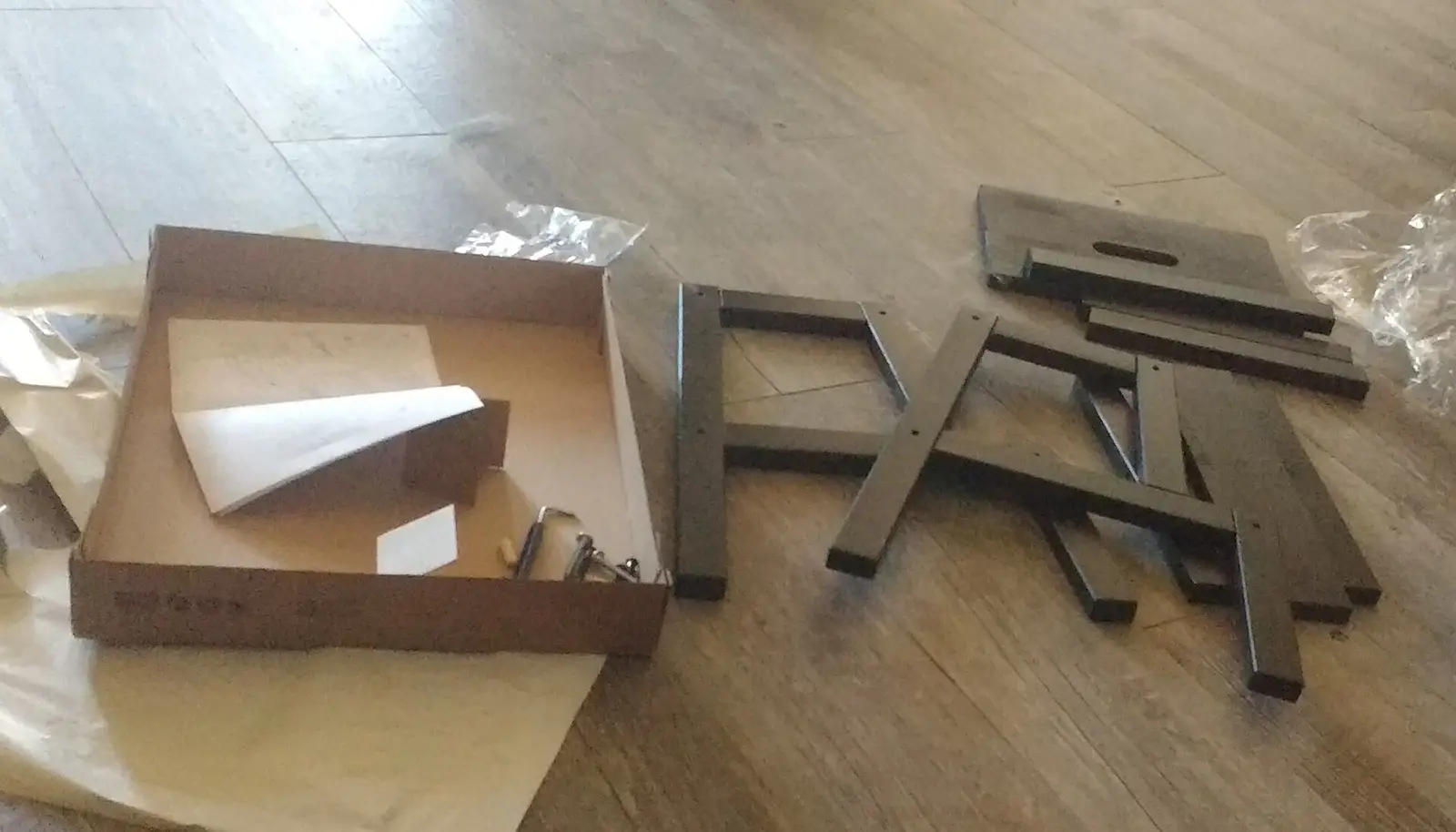
The parts of a flat-pack table laid out on a wood floor next to its open box, hardware and instructions. Photo: Bruce Szalwinski, CC BY 2.0, via Wikimedia Commons.
CSLB license class
C-6 Cabinet, Millwork and Finish Carpentry, D-34 Prefabricated Equipment
Where it applies
San Francisco, Peninsula, East Bay, South Bay
Request
Free, up to five local pros reply
Furniture assembly jobs on Bay Area homes
Dressers and chests with interlocks and a tip restraint
Under the federal rule for clothing storage units, a unit sold flat-packed may leave its drawer interlocks for the buyer to install, while one shipped assembled must have them in place. The interlocks count in the rule's stability tests, so leaving them out of the build undoes part of what the piece was tested for. The same rule packs an anti-tip device meeting ASTM F3096 in the box. IKEA's safety page adds two habits for any chest: heavy things in the lowest drawers, and never a TV on top.
Bookcases whose backs are only stapled on
FEMA's sheet on anchoring tall bookcases warns that some cases have backs of very thin material held by small screws or staples that pull out easily, and says those should be anchored with brackets rather than screws through the back. Whatever the hardware, its screws should reach at least 2 inches into the wall and the stud behind it. Two cases standing side by side are steadier joined to each other as well as to the wall. Bookcases fall outside the federal dresser rule, so a tip kit may not be in the box.
Cribs, where a missing screw is a hazard
The CPSC's crib checklist asks for no missing, loose, broken or improperly installed screws, brackets or other hardware on the crib or its mattress support, and warns that incorrectly assembled cribs have caused entrapment and suffocation deaths. The federal standards that took effect on June 28, 2011 ended the making and selling of traditional drop-side cribs and required stronger mattress supports and more durable hardware. The crib's tracking label carries its date of manufacture, and the registration form exists so the maker can reach the owner about a recall.
Wardrobes, closet systems and the line into built-ins
A freestanding wardrobe is furniture; IKEA asks that chests, dressers and other clothing storage be attached to the wall, and that at least one side reach a stud, whose framing may be wood or metal. Once the storage becomes part of the house the license classes change: the CSLB lists prefabricated closet systems under D-34, and making and installing cabinets and cases in a structure is C-6 work. A wall-hung closet system or a run of built-in cabinets past the $1,000 line is a job for a licensed contractor (C-6 or D-34).
TV stands and media consoles
The federal dresser rule names entertainment furniture among the products it does not cover, so nothing obliges a TV stand to pass a tip test or carry a restraint. The CPSC's advice for TVs and furniture is to anchor them to the wall, and where that is not possible, to set the TV on a sturdy, low base, push it as far back as it will go and keep cords out of reach. Toys and remotes stored up high tempt a child to climb, so the CPSC says to keep heavier things on the lower shelves.
The license this work needs
C-6 Cabinet, Millwork and Finish Carpentry
D-34 Prefabricated Equipment
Business and Professions Code 7026 defines contracting as work to construct, alter, repair or improve a building, structure, project, development or improvement; freestanding furniture is not named in it. Built-ins sit on the other side: the C-6 class makes cabinets, cases and other finish carpentry and installs them in structures, and the D-34 class lists prefabricated closet systems. Section 7048 exempts a job under $1,000 in labor and materials that needs no permit, unless it is split to stay under that line or the person advertises as a contractor or uses employees. Check numbers at cslb.ca.gov.
The Earthquake Country Alliance calls bookcases, china hutches and dressers top-heavy and likely to fall during an earthquake, possibly blocking exits. It advises fixing each piece to at least two wall studs with nylon strap kits, which let the furniture sway slightly without going over, and advises against rigid metal L brackets, which can break where they bend in strong shaking. FEMA's 2008 sheet still shows L brackets as one option. FEMA's homeowner guide asks for top-heavy pieces beside exits, such as tall armoires, china cabinets and bookcases, to be anchored to studs directly or with straps.
Walls that will not hold a screw by themselves
FEMA puts it plainly: screws embedded only in drywall or plaster will pull out. IKEA's wall guide sorts walls into two kinds. Stud walls are framed with vertical studs of wood or metal, and at least one side of the furniture should go into one. Solid walls of concrete or brick need a hammer drill, a masonry bit and a plug. In a Bay Area Eichler there is a third surface: San Jose's design standards for these houses note walls that often carry mahogany paneling, and full-height glass across the back.
Mirrors and glass on the way to the curb
Two of the region's bulky-item programs treat glass differently. San Jose's Junk Pickup accepts no glass or mirrors at all, and its item list tells owners to take the glass or mirror out of a dresser, bookcase or cabinet and put it in the trash, and to tape an armoire's doors shut. Recology's San Francisco program asks for glass, ceramic and mirrored items to be wrapped, and for a display case to be wrapped in cardboard or taped together. Either way the old piece is prepared before the truck arrives.
Recology's Bulky Item Collection serves only San Francisco residents with an active account: two collections a calendar year for residential customers, one for tenants in an apartment building, and none carried over. Both can be used together, depending on availability. Items go out neatly in front of the address no earlier than 6 p.m. the evening before and no later than 6 a.m., with a sheet marked RECOLOGY attached so city agencies know they are booked.
Recology San Mateo County gives residential customers two curbside Bulky Item Collection appointments a year on their regular collection day, bookable from February 1 through December 31; tenants in multi-family buildings go through the property manager. Menlo Park's notice lists what a pickup takes, including one bulky item such as a mattress or couch, and turns away anything longer than 5 feet, so a long headboard or bed rail may need to come apart first.
In Oakland, every household, owner or renter, can book one bulky drop-off of up to four cubic yards at the Davis Street Resource Recovery Complex in San Leandro and one curbside pickup, through 1-888-WM-BULKY or online. Single-family homes can add a second curbside pickup at no added cost 45 days after using both. Single-family appointments are normally scheduled within two weeks, and none are offered during the holiday tree period.
San Jose's free Junk Pickup is booked through San Jose 311 for single-family homes and apartment complexes alike, with up to 12 items a request, collected on the regular garbage day. The city's item list is specific about furniture: bed frames and cribs come apart, loose pieces are tied into bundles, and a headboard and footboard each count as an item.
Permits and rules to know
The STURDY rule for dressers (16 CFR part 1261)
Congress passed the STURDY law in 2022, and the CPSC's rule under it covers clothing storage units made after September 1, 2023: freestanding chests, dressers, armoires and similar bedroom pieces at least 27 inches tall, weighing at least 30 pounds, with 3.2 cubic feet or more of enclosed storage. Each must pass three stability tests, one with drawers loaded, one with a horizontal push and one with a 60-pound weight hung from the front while a block under the rear legs mimics carpet. Built-in units, bookcases and office furniture are outside it.
Bunk bed guardrails (16 CFR parts 1213 and 1513)
A bunk bed, to the CPSC, is one whose mattress foundation sits more than 30 inches off the floor. The upper bunk needs at least two guardrails, one on each side, and the rail on the wall side, or the side away from the ladder, must run from one end of the bed to the other. Rails must be attached so that a fastener has to be released, or the rail moved two ways in turn, before it comes off, and their tops must stand at least 5 inches above the mattress, measured with the thickest mattress the maker recommends.
Mattress take-back under Public Resources Code 42992
California's Used Mattress Recovery and Recycling Act has required retailers since July 1, 2014 to offer to pick up a used mattress for recovery, at no added cost, when they deliver a new one; they may still charge for delivery, and may refuse a mattress they find contaminated. Since January 1, 2021, a retailer whose mattress arrives by common carrier, as a boxed online order does, must offer to arrange that pickup within 30 days. The Mattress Recycling Council's Bye Bye Mattress program takes mattresses at participating drop-off sites at no added cost.
Before you hire
Ask whether the anti-tip device from the box will go in, and which screws or anchors they will bring for your particular wall.
Ask how they will find the studs, and how they fix to plaster, metal studs, concrete or brick when a stud is not where the furniture stands.
For a crib or bunk bed, ask that every screw and bracket in the manual is used, and keep the manual, tracking label and registration card.
If the job turns into built-in cabinets or a wall-hung closet system, ask whether it still fits the $1,000 handyman line or needs a C-6 or D-34 license.
Ask who takes the old piece apart for the city's bulky pickup, and whether its glass and mirrors come out first.
Ask who breaks down the cardboard, bags the foam and film, and where the packaging ends up.
Once a job passes $1,000 in labor and materials, look the license up at cslb.ca.gov and ask for proof of workers' compensation coverage.
How a request works
Describe the job
A few sentences and a photo of the problem or the space. It takes about a minute.
Local pros get in touch
Up to five handymen or contractors who take this kind of work may call or text to ask questions and quote.
Check, compare, decide
Look up the license, compare what you hear, and agree the scope and price with the one you pick. Requesting costs nothing.
Questions about furniture assembly work in the Bay Area
Does someone need a contractor's license to assemble furniture in California?
Not for freestanding furniture on its own. The contractor definition in Business and Professions Code 7026 is written around buildings, structures, projects, developments and improvements, and does not mention furniture. Built-ins are another matter: installing cabinets and cases in a structure is C-6 work, and prefabricated closet systems are listed under D-34. Any job under $1,000 in labor and materials that needs no permit is exempt anyway, unless the person advertises as a contractor or has someone else help.
The dresser came with a plastic strap. Is that enough to hold it?
The strap is only half of it. The federal rule requires an anti-tip device in the box, but IKEA tells buyers to pair it with the right hardware for their wall type, and FEMA warns that screws set only in drywall or plaster will pull out. The screw at the wall end should reach a stud, at least 2 inches in by FEMA's guidance, or use a plug suited to a concrete or brick wall.
Should a tall bookcase be held with L brackets or nylon straps?
The two main sources differ. FEMA's 2008 sheet on tall bookcases shows metal L brackets along the top or sides, or screws through a sturdy back. The Earthquake Country Alliance advises against L brackets, because they cannot flex in strong shaking and can break where they bend, and prefers nylon strap kits screwed to at least two studs. Both agree the screws must reach the studs.
Can we set up the crib a relative gave us?
Check its age first. CPSC guidance treats a crib whose tracking label or registration form shows manufacture after June 28, 2011 as needing no further proof that it meets the current standards. For an older one it points to a certificate or test report from the maker, and says a crib bought before that date with no label probably has no certificate showing it meets them. Traditional drop-side cribs can no longer be made or sold. Any crib missing a screw or bracket, or with loose or broken hardware, should not be used.
Our new mattress arrived in a box by parcel carrier. Does anyone have to take the old one?
The retailer does, if it is in decent shape. Since January 1, 2021, a California retailer whose mattress is delivered by common carrier must offer to arrange a pickup of the used one for recycling within 30 days of delivery. It may refuse one it finds contaminated. The law's definition of a mattress also covers a foundation and a futon mattress, and the Bye Bye Mattress program lists free drop-off sites.
Does the mattress on a top bunk matter for safety?
Yes. The federal bunk bed rule requires the top of each guardrail to sit at least 5 inches above the mattress, tested with the thickest mattress the maker recommends. A thicker mattress than that can leave the rail too low to do its job, so check the size printed in the instructions or on the warning label before buying one.
Checked against these public sources in October 2026. Codes and programs change: confirm permit rules with your city's building department and a license on the CSLB website before work starts.