New floors over Bay Area slabs, crawlspaces and old vinyl tile
Most flooring jobs on Bay Area houses are decided by what lies underneath: a concrete slab that may hide radiant heating pipes or push up moisture, a wood subfloor over a crawlspace, or vinyl and black adhesive laid before 1981, which Cal/OSHA treats as asbestos until a test says otherwise. Installing carpet, resilient flooring or wood is C-15 work. A new floor covering rarely needs a permit; repairing the structure under it often does.
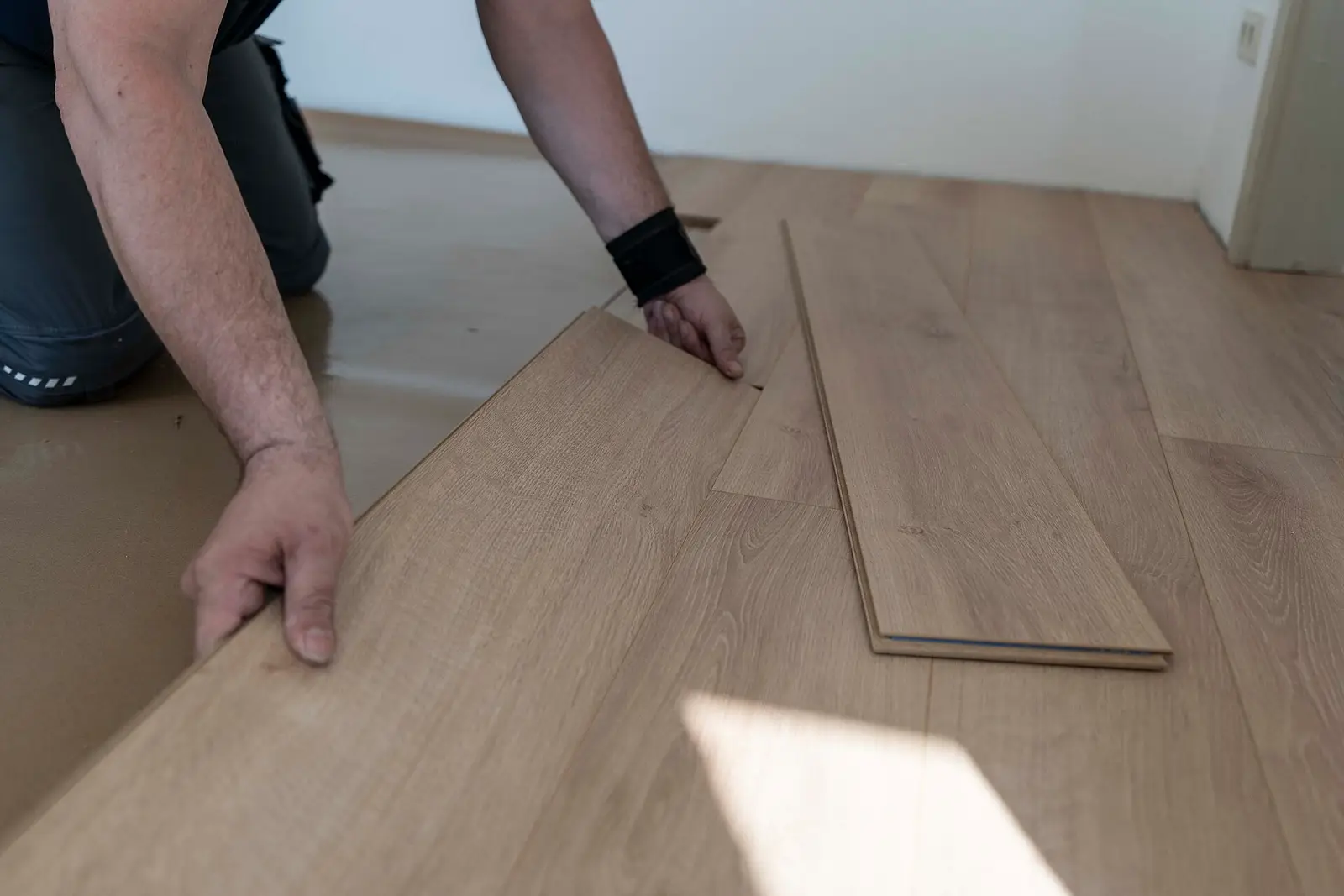
Hands fitting a wood-look laminate plank into the row beside it over a foam underlay. Photo: Raphael Mecke, CC BY 4.0, via Wikimedia Commons.
CSLB license class
C-15 Flooring and Floor Covering, C-54 Ceramic and Mosaic Tile
Where it applies
San Francisco, Peninsula, South Bay, East Bay
Request
Free, up to five local pros reply
Flooring jobs on Bay Area homes
Pulling up carpet, and where the old roll goes
California's Carpet Stewardship Program, overseen by CalRecycle and run by CARE, the nonprofit the carpet makers set up, draws its funds from an assessment state law requires on carpet purchases. CARE drop-off sites take old carpet only when it is dry and clean: tack strips, nails and trash removed, cut into manageable sections, and rolled apart from the pad. CARE says carpet damaged by water, fire or smoke cannot be recycled, and area rugs under 11 by 15 feet fall outside the program. Ask the installer which site will get the roll.
Covering old resilient flooring instead of tearing it out
Where old vinyl or asphalt tile might contain asbestos, EPA's advice to homeowners is to install the new floor covering over it if possible, and never to sand it or try to level it or its backing. A floating floor, or new underlayment fastened over sound tile that is still stuck fast, leaves the old layer as it is. Whether a product may go over existing resilient flooring is set by its own installation instructions, so ask to see the page that says so before the order is placed.
Removing vinyl, sheet goods and adhesive laid before 1981
Cal/OSHA's asbestos standard for construction has employers and building owners treat asphalt and vinyl flooring installed no later than 1980 as asbestos-containing, mastic and backing included, until an industrial hygienist shows otherwise. Its removal rules forbid sanding the flooring or its backing, ripping up resilient sheeting, sweeping dry, and mechanical chipping outside a negative-pressure enclosure; tiles come up whole where possible and leftover adhesive is scraped wet. Where the material does contain asbestos, removing 100 square feet or more is work for a contractor registered with Cal/OSHA, which for an unrestricted registration means a C-22 Asbestos Abatement license.
Engineered wood and plank over a radiant-heated slab
Each flooring maker writes its own rules for radiant heat, and they differ from product to product. Kentwood's December 2025 installation guide is a fair example: it bars all of its acacia and hickory floors from radiant installations and voids the warranty if they are used, and it makes the homeowner responsible for getting written confirmation from the heating system's maker that the system suits engineered wood and under what operating conditions. On a slab with pipes cast inside, a floor that floats or is glued down keeps every fastener out of the concrete.
Testing a slab before glue-down flooring
ASTM's standard for measuring relative humidity in concrete slabs says excess moisture under a floor covering can cause debonding, peaking, deterioration of the finish and microbial growth, and that most flooring makers require a moisture test before installing on concrete. Kentwood's guide accepts either of two methods: ASTM F2170, which reads humidity with probes placed in the concrete, with a limit of 75 percent, or ASTM F1869, which measures vapor leaving the surface, with a limit of 3 pounds per 1,000 square feet in 24 hours. A slab that fails needs more curing or a moisture barrier.
Wood floors over a crawlspace
On a raised foundation the floor rests on joists over a crawlspace, and the crawlspace decides how a wood floor behaves. Kentwood's guide wants a crawlspace dry, free of standing water and cross-ventilated, with a vapor retarder laid over any exposed earth. It also asks for the house to hold 60 to 80 degrees Fahrenheit and 30 to 50 percent relative humidity for five days before the flooring is even delivered. Sanding and refinishing an existing wood floor, or weaving new boards into it, is C-15 work just as a new installation is.
The license this work needs
C-15 Flooring and Floor Covering
C-54 Ceramic and Mosaic Tile
The CSLB's C-15 class prepares surfaces and installs carpet, resilient sheet goods and tile, and wood floors, including finishing and repairing them, but not ceramic tile, which belongs to the C-54 class. Someone without a license may take a floor job only while labor and materials together stay under $1,000 and no permit is needed. Since January 1, 2026, Business and Professions Code 7048 withholds even that exemption from anyone who employs another person to do or help with the work. Past those lines, look the license number up at cslb.ca.gov.
Palo Alto's Eichler design guidelines count some 2,700 of Joseph Eichler's houses in that city alone and describe his model as slab foundations containing radiant heating pipes, after Frank Lloyd Wright's Usonian houses. The guidelines add that the plumbing was placed in the slab too, and that both can be hard to repair without highly invasive work. The same construction runs through the Eichler tracts of San Jose's Willow Glen and Western districts. Any nail, screw or drill bit that finds a pipe turns a floor job into a slab repair.
Postwar houses and their original floors
Much of the Bay Area's suburban housing went up in the postwar decades. Fremont's historic context counts nearly 60 tracts platted there between 1953 and 1955 alone, and Palo Alto's map of Eichler tracts runs from 1949 to 1974. Every original resilient floor in houses of those years falls inside Cal/OSHA's presumption for flooring installed by 1980, and so does an older layer hidden under later carpet or laminate. EPA notes that asbestos usually cannot be identified by looking at a material, and that material in good condition that will not be disturbed is best left alone.
California's formaldehyde limits on composite panels
In 2007 the California Air Resources Board adopted limits on formaldehyde emissions from hardwood plywood, particleboard and medium density fiberboard, and from finished goods made with them, naming flooring among its examples. The federal standard under TSCA Title VI is set at the same levels, and EPA says regulated products made in or imported into the United States after March 22, 2019 must pass third-party certification and be labeled TSCA Title VI compliant. Engineered wood and laminate can be built on these panels; ask which core a product uses and look for the label on the box.
San Francisco's list of work exempt from a building permit takes in installing or replacing floor coverings in areas other than bathrooms, and only where no existing required flooring has to come out. A new bathroom floor is therefore permit work in the city, unlike in places that exempt every floor finish, and so is a job that removes flooring the code requires. Ask the Department of Building Inspection before a bathroom floor is torn up.
Palo Alto's Household Hazardous Waste Station on Embarcadero Way accepts asbestos from residents only in small amounts: wetted, double-bagged in bags no larger than 3 feet on a side, two bags at most. The station turns away pressure-treated wood, so old treated sleepers or thresholds need another route. For a whole floor of old tile, ask the abatement contractor where it will be taken.
CARE's October 2026 booklet lists nine carpet drop-off sites in Santa Clara County: five with San Jose addresses, among them GreenWaste Carpet Recycling on Old Bayshore Highway, Zanker Recycling on Los Esteros Road and Guadalupe Recycling and Disposal Facility, plus the SMaRT Station on Carl Road in Sunnyvale and sites in Morgan Hill and Gilroy. CARE asks callers to confirm hours, rates, accepted carpet types and identification before driving over.
RE:Source, the disposal directory StopWaste runs for Alameda and Contra Costa counties, lists carpet rules site by site. The Berkeley Transfer Station takes carpet for recycling clean, dry, rolled separately from the pad and cut into 4-foot sections, and charges it at the construction and demolition base rate. The Fremont Recycling and Transfer Station takes broadloom and carpet tile in its separate construction and demolition drop-off area. Alameda County's household hazardous waste facilities do not accept asbestos.
Permits and rules to know
Floor coverings versus the floor beneath them
Bay Area building departments repeat the state code's exemption for finish work in their own handouts: Fremont exempts painting, papering, tiling, carpeting and similar finish work, and San José lists floor finishes such as carpet, linoleum and tile as cosmetic. The exemption for ordinary repairs stops at structure; Palo Alto's handout, quoting Section 105.2.2, says such repairs may not include removing or cutting any structural beam or load-bearing support. San José puts a number on the subfloor, exempting sheathing repairs only up to 10 square feet. Past that, or into the joists, apply for a permit.
CALGreen when the floor is part of an addition
California's green building code reaches flooring only on certain permitted work. Section 301.1.1, as Pleasanton's residential checklist quotes it, applies the mandatory residential measures to additions and alterations that increase a building's conditioned area, volume or size, and only within that area. There, at least 80 percent of the floor area receiving resilient flooring must meet the state's emissions test, for example through FloorScore certification, carpet must meet a program such as the Carpet and Rug Institute's Green Label Plus, and adhesives must stay within VOC limits, 100 grams per liter for wood flooring adhesive.
Air District sampling under Regulation 11, Rule 2
The Bay Area Air District's asbestos rule spares a building of four or fewer dwelling units the full survey it demands elsewhere, but still requires a sample and lab test before resilient flooring is removed or disturbed. Material found to hold more than 1 percent asbestos and to be friable is then handled under the rule's removal standards, and the rule counts linoleum and its backing as friable. A renovation removing 100 square feet or more of regulated asbestos needs written notice 10 working days ahead, or 72 hours for a house of four or fewer units once the fees are paid.
Before you hire
Past $1,000 in labor and materials, or any permit, look up the C-15 number at cslb.ca.gov, or C-54 for tile.
Ask who else will work on the job: since 2026 a person without a license who employs a helper cannot rely on the under-$1,000 exemption.
In a house built before 1981, ask who will sample the old flooring and adhesive, and what happens if the result is positive.
On a slab, ask which moisture test the flooring maker requires, F2170 or F1869, and ask to see the readings.
Over radiant heat, ask for the flooring maker's radiant instructions and the heating system maker's written confirmation.
For laminate or engineered wood, ask to see the TSCA Title VI label on the cartons.
Ask where the old carpet and pad will go, and whether they will be kept dry and separate for a CARE drop-off site.
How a request works
Describe the job
A few sentences and a photo of the problem or the space. It takes about a minute.
Local pros get in touch
Up to five handymen or contractors who take this kind of work may call or text to ask questions and quote.
Check, compare, decide
Look up the license, compare what you hear, and agree the scope and price with the one you pick. Requesting costs nothing.
Questions about flooring work in the Bay Area
Can a handyman install my new floor without a contractor's license?
Only a small job. California lets someone without a license take work whose total for labor, materials and everything else is under $1,000 and that needs no building permit. Since January 1, 2026, that exemption no longer applies to a person who employs anyone to do or help with the work. Past either limit the floor is C-15 work, or C-54 if it is ceramic or stone tile, and the license number can be checked at cslb.ca.gov.
Does replacing carpet with vinyl plank need a building permit in the Bay Area?
Usually not. Fremont, San José and Palo Alto all list carpeting, tile or similar floor finishes as work exempt from permit. San Francisco is narrower: it exempts floor coverings outside bathrooms when no required flooring has to be removed. What changes the answer is the structure underneath. San José exempts subfloor sheathing repairs only up to 10 square feet, and cutting or replacing a joist is never an ordinary repair.
How do I know if the old vinyl in my kitchen contains asbestos?
Only a lab test tells you. EPA says you usually cannot tell by looking, that sampling should be left to a trained professional, and that material in good condition that will not be disturbed can stay put. Cal/OSHA has contractors treat asphalt and vinyl flooring installed by 1980 as asbestos-containing, with its mastic and backing, and the Bay Area Air District requires a sample before resilient flooring in a house of four or fewer units is removed or disturbed.
Can new flooring go right over the old vinyl tile?
Often, and EPA prefers it where the old floor may contain asbestos: its advice is to install new floor covering over asbestos flooring if possible, and never to sand or level it. The deciding document is the new floor's installation guide, which sets what it may be laid over and how flat and sound that surface must be. Loose or broken old tile is a different question, because lifting it is removal.
What can be done with the old carpet from a Bay Area house?
Recycle it through California's carpet stewardship program. CARE's drop-off map and booklet list sites across the region, from transfer stations to flooring stores. Carpet has to be dry, free of tack strips, nails and trash, cut into sections and rolled separately from the pad; carpet damaged by water, fire or smoke cannot be recycled. Call the site first to confirm hours, rates and what it accepts.
What does the TSCA Title VI label on a box of laminate mean?
It means the composite wood in the product passed third-party certification to the federal formaldehyde emission standards. EPA requires hardwood plywood, medium density fiberboard and particleboard, and goods containing them, made in or imported into the United States after March 22, 2019, to carry that label. California's Air Resources Board set the same limits first, in a 2007 rule whose list of finished goods names flooring.
Checked against these public sources in October 2026. Codes and programs change: confirm permit rules with your city's building department and a license on the CSLB website before work starts.