Doors that bind, drag or won't latch in Bay Area houses
Most door calls in the Bay Area begin with a door that has stopped closing: it rubs the jamb, binds at the head or will not latch. Loose hardware is the usual culprit, but civil engineers also list sticking doors among the signs of shrink-swell clay moving a house. One door carries a code of its own: the one from an attached garage into the house, which California requires to be solid or fire-rated, self-closing and self-latching.
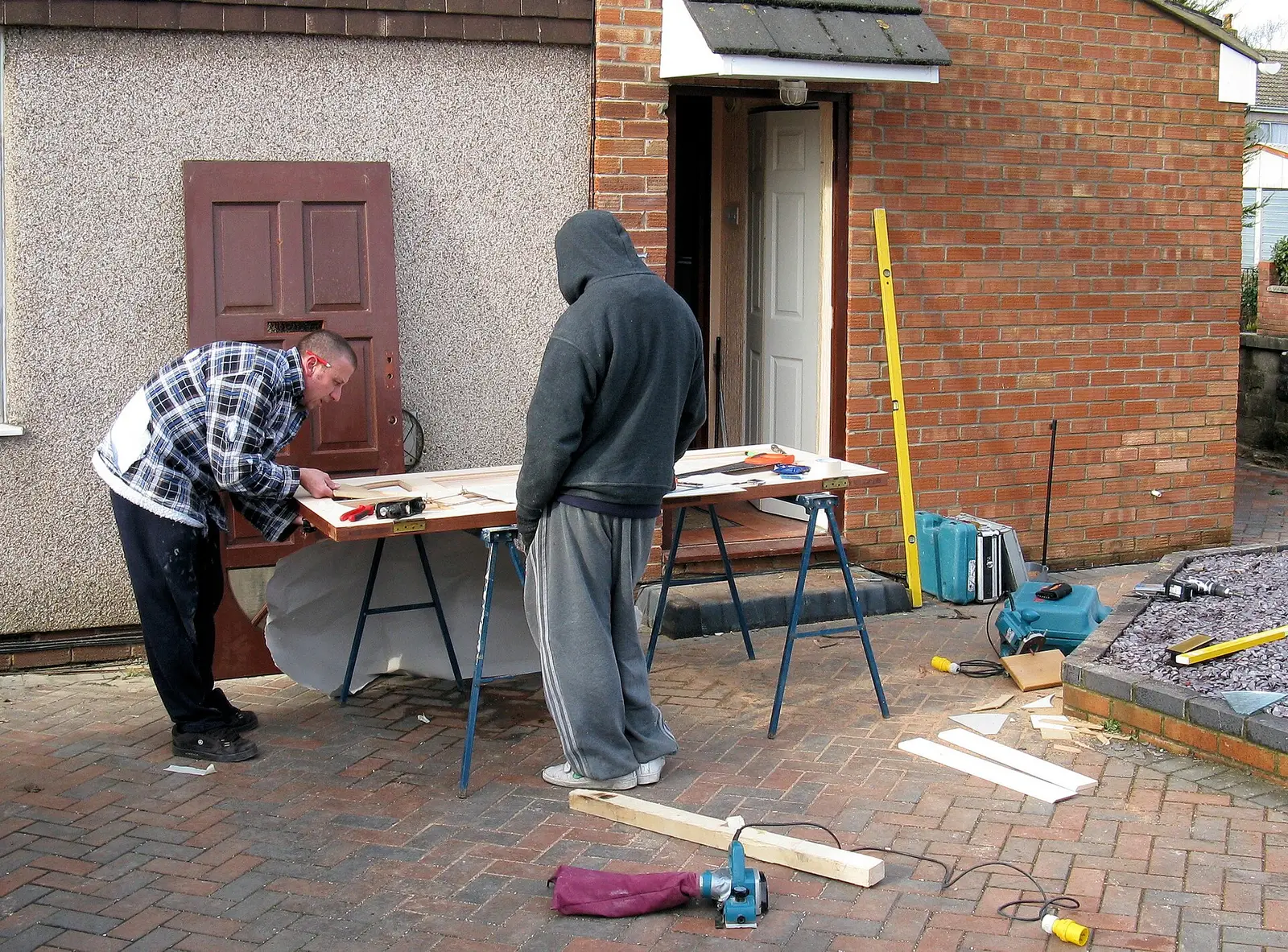
Two men working on a wooden door laid across sawhorses outside a brick house, with a power planer and a level nearby. Photo: Adrian Pingstone (Arpingstone), Public domain, via Wikimedia Commons.
CSLB license class
D-28 Doors, Gates and Activating Devices, C-6 Cabinet, Millwork and Finish Carpentry, C-17 Glazing
Where it applies
San Francisco, Peninsula, East Bay, South Bay
Request
Free, up to five local pros reply
Door jobs on Bay Area homes
Freeing a door that binds or will not latch
The first checks are the hardware: hinge screws that have worked loose let a slab sag toward the latch side, and a strike plate out of line stops the latch from catching. When several doors in one house start sticking at the same time, the picture changes. The ASCE Geo-Institute's homeowner guide to shrink/swell soils lists sticking doors with warped frames, gaps between door frames and walls, and cracks above doors among the signs of foundation movement, and says the odds rise with each sign found.
The door from the garage into the house
In a house with an attached garage, the connecting door is part of the fire separation between the two. The 2025 California Residential Code allows solid wood or solid or honeycomb-core steel at least 1 3/8 inches thick, or a 20-minute fire-rated door, and requires it to be self-latching with a self-closing or automatic-closing device. A hollow-core interior slab is the swap to refuse here. The Energy Code exempts a fire-protection door in this spot from its door U-factor limit, so efficiency is no reason to pick a lighter one.
Deadbolts on rental entry doors
Civil Code 1941.3 has required California landlords since July 1, 1998 to install and maintain an operable deadbolt on each main swinging entry door of a dwelling unit, with a bolt that reaches at least 13/16 of an inch past the strike edge into the jamb. Older half-inch deadbolts still satisfy it, and the statute excludes horizontal sliding doors. Certain older thumb-turn deadlocks qualify only until the first time they need repair or replacement; then the landlord must fit a 13/16-inch deadbolt. Tenants are expected to report a lock that stops working.
A new exterior door in the old opening
A prehung exterior door is an Energy Code product. Section 110.6 allows a manufactured exterior door only when its maker has shown the Energy Commission an air leakage rate no higher than 0.3 cubic feet per minute per square foot of door area for residential doors, and the door must carry a temporary label. A door built on site has to be caulked to the building and weatherstripped instead. A door that is a quarter or more glass counts as a glazed door and is held to the window rules, while added swinging door area that is opaque must meet a U-factor of 0.20.
Sliding, French and other glass doors
The residential code treats glazing in the fixed and operable panels of swinging, sliding and bifold doors as a hazardous location, which means safety glazing. Its exceptions are narrow: openings too small for a 3-inch sphere to pass through, and decorative glazing. A dragging patio slider is often a roller and track job, while replacing the glass in a door or the whole unit is glazing work. The CSLB's D-28 class names glass sliding and stationary doors and frames, and C-17 covers the glazing of doors.
Widening a doorway or cutting a new one
Moving beyond the existing opening turns door work into framing. A wider opening needs a new header and often brings wall finish, trim and electrical work along with it, which is where a B General Building contractor comes in: that class takes projects that use at least two unrelated building trades. If the new door becomes the house's required egress door, the residential code sets its minimum size and opening hardware, and the Energy Code's 2025 alteration rules hold any added exterior door area to the same U-factor as a new house.
The license this work needs
D-28 Doors, Gates and Activating Devices
C-6 Cabinet, Millwork and Finish Carpentry
C-17 Glazing
Door work spans three CSLB classes. D-28 names wood and screen doors, metal-clad doors, glass sliding doors and their frames, and manually operated door hardware. A C-6 contractor makes and installs doors, trim and other finish carpentry, and a C-17 contractor glazes frames, sashes and doors. Tightening hinges, resetting a strike or swapping a lockset stays handyman work while the whole job is under $1,000 and needs no permit. Above that line, check the license number at cslb.ca.gov.
Clay that swells in the rains and shrinks in summer
Parts of the Bay Area sit on clays that change volume with water. The City of Livermore's draft environmental report for its Isabel Neighborhood Plan area, in the northwestern Livermore Valley, describes the Diablo, Rincon, Linne and Pescadero clay or clay-loam soils there as moderately to highly expansive, able to shrink and swell with water and crack foundations and walls. The ASCE Geo-Institute's guide says keeping soil moisture uniform next to and under the foundation is the most useful thing an owner can do, and recommends downspouts that discharge at least 5 feet from the house.
Earthquakes rack door frames
The USGS puts the chance of at least one magnitude 6.7 or larger earthquake in the San Francisco Bay region between 2014 and 2043 at 72 percent. The American Red Cross advises that a door jammed after a disaster should not be forced, because it may be providing support to the rest of the home, and that a building inspector or contractor should check the structure first. A door that jams right after a quake is a question about the structure before it is a carpentry job.
Lead paint on old doors and jambs
EPA's Renovation, Repair and Painting rule covers housing built before 1978, and its definition of renovation names the modification of painted doors and the planing of thresholds to fit weatherstripping. Small jobs are exempt only at 6 square feet or less of painted surface per room inside, or 20 square feet outside, and when a painted part is removed its whole surface counts, so taking out an old painted door is more than a small job. Power planing a painted edge is prohibited unless the tool has a shroud with a HEPA vacuum attachment.
San Francisco's Department of Building Inspection lists replacing inside doors among the jobs that need no permit, unless the door is required for fire protection, and the same list exempts repairing or replacing glass. Exterior doors are not on it. The door from an attached garage into the house is one of the doors the exemption leaves out, since the residential code sets its fire protection.
The City of San Mateo's Building Security Code requires exterior doors, and doors from a garage into a single-family house, to be solid core at least 1 3/8 inches thick, with a deadbolt of at least a one-inch throw in addition to a deadlatch, strike plates fixed with 2 1/2-inch screws and a 180-degree peephole in each main entry door. It applies to new construction; repairs and alterations to an existing single-family house do not trigger it.
The Town of Danville requires a building permit for every residential patio and exterior door replacement, whether or not the frame changes. Its handout, revised in December 2025, asks for three copies of a floor plan showing every existing and proposed door and its size, and reminds applicants of the landing rules: a floor or landing on each side, and the main entry no more than 1 1/2 inches below the threshold.
Santa Clara's single-family design guidelines treat doors as part of a house's architecture. They ask that new doors on an addition match the existing ones in material, style, orientation and placement, that sliding glass doors in aluminum frames face away from street views, and that the city's Eichler and mid-century patio homes avoid raised-panel doors and other details from different styles.
Permits and rules to know
Opening protection between garage and house
Section R302.5.1 of the 2025 California Residential Code, in effect since January 1, 2026, bars any opening from a private garage directly into a room used for sleeping. Other openings between the garage and the dwelling need solid wood doors at least 1 3/8 inches thick, solid or honeycomb-core steel doors at least 1 3/8 inches thick, or 20-minute fire-rated doors. The doors must be self-latching and have a self-closing or automatic-closing device. Ducts through that wall are covered separately, by Section R302.5.2.
The required egress door and its landing
Every dwelling unit needs at least one egress door under Section R318.2 of the 2025 Residential Code. It must be side-hinged, give a clear width of at least 32 inches with the door open 90 degrees and a clear height of at least 78 inches, and open from inside without a key or special knowledge or effort. Section R318.3 requires a landing on each side of an exterior door, at least 36 inches deep, and puts the floor at the egress door no more than 1 1/2 inches below the threshold.
Exterior doors in fire hazard severity zones
Section 504.9 of the 2025 California Wildland-Urban Interface Code lists the exterior doors it accepts on the buildings it covers: noncombustible construction, solid-core wood at least 1 3/4 inches thick, solid-core wood with stiles and rails at least 1 3/8 inches and raised panels at least 1 1/4 inches thick, a door with a 20-minute fire protection rating, or cladding that passes the named fire tests. Glass in a door must follow the code's exterior glazing section. Ask the building department whether a replacement door must meet it.
Before you hire
Ask whether the door from the garage will be solid-core or fire-rated, self-closing and self-latching, and look for the rating label.
If several doors stick at once, ask the pro to look for cracks above the frames before anything is planed.
In a house built before 1978, ask whether the firm doing the work is certified by EPA for lead-safe renovation.
Ask whether your city needs a permit for an exterior door in the same opening; Danville requires one for every replacement.
Ask to see the temporary energy label on a new manufactured exterior door before it is hung.
Once the job passes $1,000, check the D-28, C-6 or C-17 license number at cslb.ca.gov.
Ask for proof of workers' compensation coverage before anyone starts work.
How a request works
Describe the job
A few sentences and a photo of the problem or the space. It takes about a minute.
Local pros get in touch
Up to five handymen or contractors who take this kind of work may call or text to ask questions and quote.
Check, compare, decide
Look up the license, compare what you hear, and agree the scope and price with the one you pick. Requesting costs nothing.
Questions about door work in the Bay Area
Can the door from our garage into the house be an ordinary hollow-core door?
No. Section R302.5.1 of the California Residential Code allows only solid wood or solid or honeycomb-core steel at least 1 3/8 inches thick, or a 20-minute fire-rated door, and the door must be self-latching and self-closing. A garage may not open directly into a bedroom at all. San Francisco's permit exemption for replacing inside doors does not cover a door required for fire protection.
Several of our doors started sticking at once. Is it the doors or the house?
Possibly the house. The ASCE Geo-Institute's guide lists sticking doors, gaps between door frames and walls, and cracks above doors among the signs of shrink/swell soil movement, and says the likelihood rises with the number of signs present. If it began after an earthquake, the Red Cross advises not forcing a jammed door, because it may be supporting the structure.
What lock must a California landlord put on the front door?
An operable deadbolt on each main swinging entry door, with a bolt that extends at least 13/16 of an inch beyond the strike edge into the jamb, under Civil Code 1941.3. Existing deadbolts of at least half an inch still qualify. Sliding doors are excluded, and the section does not apply to buildings designated historically significant by a local, state or federal jurisdiction.
Can a door be planed down in a house built before 1978?
Yes, with care. EPA's lead renovation rule names the modification of painted doors as renovation, and prohibits power planing a painted surface unless the planer has a shroud with a HEPA vacuum attachment. Small jobs of 6 square feet or less of painted surface per room are exempt, but only when none of the restricted practices are used.
Why did the inspector care about the step outside our new back door?
Because the residential code sets landings at exterior doors. Section R318.3 calls for a floor or landing on each side, at least 36 inches deep, and an exterior door other than the main egress door may sit no more than 7 3/4 inches above the landing below it. No landing is needed where a stairway of two risers or fewer is outside and the door does not swing over it.
Is a glass-paneled entry door treated as a door or a window?
Under California's Energy Code it depends on the glass. An exterior door that is 25 percent or more glazed counts as a glazed door and must meet the window requirements, while an opaque swinging door is held to a door U-factor. Under the residential code, glass in the door's panels also needs safety glazing unless it is decorative or too small for a 3-inch sphere.
Checked against these public sources in October 2026. Codes and programs change: confirm permit rules with your city's building department and a license on the CSLB website before work starts.