Hiring one general contractor to run a Bay Area building project
A general contractor signs one contract and answers for every trade on it. In California, structural changes, new houses and fire rebuilds call for the B General Building license; the B-2 Residential Remodeling class stops at bearing walls and at extending plumbing, electrical or mechanical systems unless it holds those licenses or hires subs who do. Around the Bay Area, redrawn fire maps, landmark districts and city permit declarations shape the job early.
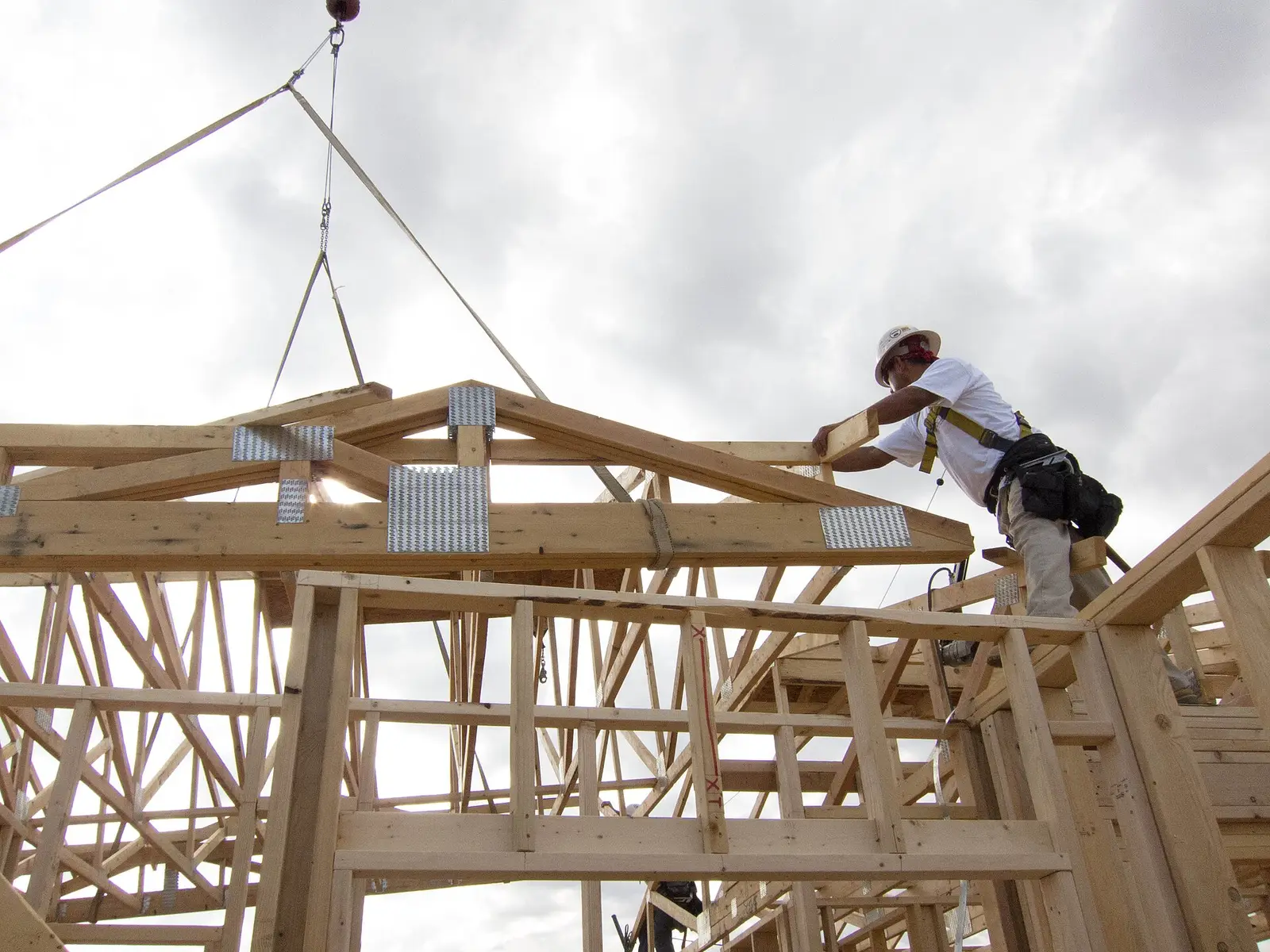
A framer in a hard hat and fall-protection harness guides a roof truss into place on a new house frame. Photo: National Institute for Occupational Safety and Health (NIOSH) from USA, Public domain, via Wikimedia Commons.
CSLB license class
B General Building, B-2 Residential Remodeling
Where it applies
North Bay, East Bay, Peninsula
Request
Free, up to five local pros reply
General contracting jobs on Bay Area homes
Rebuilding on a lot cleared after a wildfire
After the October 2017 fires, Santa Rosa laid out the order a rebuild follows. Debris comes off first, through the state program or a private crew, and private clean-up needs a demolition permit. Disposal receipts and a post-clean-up soil analysis have to be in hand before the building permit is issued, though the application can be started while the lot is still being cleared. The city may hold the original house plans; if it does not, the County Assessor's parcel record gives the footprint, or the plans are drawn again.
A remodel that reaches a bearing wall
Plenty of projects begin inside B-2 territory: cabinets, tile, flooring, fixture swaps and paint on an existing wood-frame house. The line moves when a wall turns out to carry load, the foundation needs work or roof framing has to change, because a B-2 contractor may not contract structural changes to load-bearing parts. CSLB requires any change in price or scope to go into a written change order, signed by both sides before the new work begins. Confirm at that point that the license still covers the job; often the answer is a B.
One contract, many trades
A whole-house job can mix foundation, framing, roofing, plumbing, wiring, insulation and finish work. A B general contractor may carry all of it under one prime contract, with its own crew or through subcontractors who hold their own licenses, as long as the project involves two or more unrelated trades besides framing and carpentry. CSLB's sample home improvement contract asks whether subcontractors will be used and, if so, has the contractor provide on request their names, contact details, license numbers and classifications. That list is also your key to the preliminary notices that follow.
Building a house to sell
CSLB's guidance to building officials sets out when an owner may build a house for sale without a license. With licensed contractors doing all of the work, the exemption covers no more than four structures intended for sale in a calendar year. If the owner does any of the work personally, the owner has to live in the finished house for a year before reselling, and only two structures in three years qualify. Contract the whole project to a licensed general contractor and the count limit no longer applies.
Restoring a house after a declared emergency
Fire, flood or quake damage covered by a declared state of emergency changes the paperwork. For repair or restoration of a home hit by a sudden or catastrophic event under such a declaration, CSLB's sample contract calls for a notice of a seven-day right to cancel instead of the usual three. Contracting without a license in a declared disaster area is a felony, and the license requirement reaches every stage from debris removal to rebuilding. CSLB warns that operators without a license target disaster victims, so check each license before discussing scope.
The license this work needs
B General Building
B-2 Residential Remodeling
A B contractor builds structures that take at least two unrelated trades. It may contract framing or carpentry alone, but those two never count toward the pair it needs for a job made of other work, and fire sprinklers (C-16) or a well (C-57) need that license or a sub who holds it. B-2 covers existing wood-frame homes, three or more unrelated trades per contract, no load-bearing changes, and asbestos only through a C-22 license or sub. A request reaches up to five local contractors who take this kind of work; The Handyman SF holds no license and checks none, so look yours up at cslb.ca.gov.
The State Fire Marshal's new Fire Hazard Severity Zone maps took effect in State Responsibility Areas on April 1, 2024. Maps for cities and other local areas followed in four phases between February 10 and March 24, 2025, sent to each local jurisdiction. The model rates hazard over a 30 to 50 year span from fuel, slope, fire weather and how far embers travel, which can be up to a mile, not the risk to one hardened house. Another SRA map update is open for public comment until January 8, 2027. Look up the parcel's current zone before a new house or addition is designed.
Landmark districts in San Francisco's older neighborhoods
San Francisco has more than 300 Article 10 landmarks and over 1,110 lots inside Article 10 historic districts. Exterior work that needs a permit on any of them, and new construction in a district, first needs a Certificate of Appropriateness or its administrative version, approved before the building permit; a building rated non-contributory still needs one. Landmark status can also hold a demolition permit for up to a year while alternatives are explored. Ordinary repairs that only correct decay or damage, with in-kind materials, are exempt, so the wording of the scope matters.
Buildings that also need an architect or engineer
Some Bay Area buildings are beyond what a contractor may plan alone. Berkeley's permit pages draw the line plainly: a project more than two stories and a basement in height, built with anything other than conventional wood framing, or holding more than four dwelling units on the property needs a California-licensed architect or engineer. On that kind of job the general contractor builds from the design professional's drawings, so settle early who prepares them, and check that person's license with the state Architects Board or Professional Engineers Board.
Santa Rosa created its Resilient City combining district by urgency ordinance after the Tubbs and Nuns fires of October 2017, which damaged or destroyed about 3,000 homes inside the city. Its rebuilding tools apply in six neighborhoods: Coffey Park, the Highway 101 corridor and Round Barn area, Fountainview, Fountaingrove, Montecito Heights and Oakmont. Rebuild applications go to the city's Resilient City Permit Center, so a contractor bidding there works under that district's rules as well as the base zoning.
Berkeley requires the contractor on a Berkeley project to hold a California license and a Berkeley business license. Its permit declarations then have the signer affirm, under penalty of perjury, a workers' compensation option, work within the hours of the city noise ordinance and any use-permit conditions, use the state's stormwater best management practices manual for construction, keep lead-safe practices in pre-1978 homes, and follow the Air District's asbestos rule.
Palo Alto's residential construction guide sets the hours a contractor schedules around: work and material deliveries from 8 a.m. to 6 p.m. on weekdays and 9 a.m. to 6 p.m. on Saturdays, none on Sundays or holidays, with no piece of equipment louder than 110 dBA at 25 feet. The guide says a permit may be issued only to a state-licensed contractor with the proper classification or to the homeowner, and a homeowner who hires workers needs workers' compensation in place before inspection.
Permits and rules to know
The owner-builder exemption and its limits
An owner improving their own principal residence needs no license if the work comes before any sale, they lived there for the 12 months before it was finished, and they have not used the exemption on more than two structures in three years. Property owners may not drill a well themselves. Berkeley's owner-builder declaration repeats the warning in Section 7044: if a building or improvement is sold within one year of completion, the owner-builder carries the burden of proving it was not built for sale.
The license statement on a permit application
Business and Professions Code Section 7031.5, as Berkeley's permit form quotes it, has every city or county that requires a building permit collect a signed statement that the applicant holds a license, or is exempt and on what basis. A contractor affirms under penalty of perjury that the license is in force and lists its number, class and expiration date. The same form asks for a workers' compensation declaration: an insurance carrier and policy, a state certificate to self-insure, or a promise to employ no one covered by the law.
Before you hire
Look the license up at cslb.ca.gov and confirm it lists B General Building whenever bearing walls, foundations or roof framing will change.
Ask for the list of subcontractors and material suppliers, since each may send a preliminary notice up to 20 days after starting.
Check that the contract names who obtains the permits, whether permit fees are included, and when work starts and finishes.
Ask which workers' compensation box they will check on the contract; no employees does not fit a crew that arrives every morning.
When a sub or supplier has sent a preliminary notice, pay that share with a joint check made out to the contractor and that firm.
Ask for a full and unconditional lien release covering each portion of work you have paid for before you make the next payment.
If a salesperson writes up the contract, their name and registration number belong on it beside the contractor's.
How a request works
Describe the job
A few sentences and a photo of the problem or the space. It takes about a minute.
Local pros get in touch
Up to five handymen or contractors who take this kind of work may call or text to ask questions and quote.
Check, compare, decide
Look up the license, compare what you hear, and agree the scope and price with the one you pick. Requesting costs nothing.
Questions about general contracting work in the Bay Area
Is a B-2 remodeling contractor enough for a kitchen and two baths?
Often, if the house is an existing wood-frame structure, the contract uses at least three unrelated trades, and nothing load-bearing changes. A B-2 may replace fixtures and make the minor system alterations needed to install them, but it cannot install, substantially alter or extend plumbing, electrical or mechanical systems unless it holds those licenses or subcontracts the work. Removing a wall that carries load, or running a new drain line, points to a B, or to a sub with the right license for that part.
How much can a contractor ask for before any work starts?
On a home improvement job the down payment may not exceed 10 percent of the contract price or a fixed ceiling set in state law, whichever is less, and CSLB says special-order materials are no exception. After that, payments follow the written schedule, and it is against the law for a contractor to collect for work not yet done or materials not yet delivered. A request for a large share up front is a reason to stop and reread the contract.
A lumber yard we never hired sent us a preliminary notice. Is that a lien?
No. A preliminary notice only preserves the sender's right to record a mechanics lien if it goes unpaid. Even if you pay your contractor in full, an unpaid subcontractor or supplier can record a lien and sue to foreclose it, which could mean paying twice. Get the list of subs and suppliers, note when each started, pay their shares with joint checks, and collect a release for each portion you pay.
Can we cancel a remodeling contract we signed at our kitchen table?
Usually, yes. Unless the contract was negotiated at the contractor's place of business, the Home Solicitation Sales Act gives the buyer three days to think it over, five days for buyers 65 or older, and the contractor must hand over the notice with the contract. Cancel in writing. An emergency service and repair contract below that category's price limit loses the right once it is signed and the work begins.
Our contractor suggested we take out the permit as owner-builders. What is the risk?
CSLB warns that some homeowners misstate on the permit application that they will do the work. Signing as owner-builder makes you responsible for every phase: supervising and scheduling, permits and inspections, correcting failed work, and making sure every worker and supplier is paid or facing liens on your home. If the workers hold no license, you may be treated as their employer, with payroll taxes and workers' compensation to provide. The contractor doing the work should pull the permit.
How long do we have to bring a complaint to the CSLB?
The board can investigate a complaint against a licensed contractor filed within the legal deadline, which CSLB's sample contract puts at usually four years. If the work was done without a license, the board may not be able to help, your remedy may be a civil lawsuit, and you could be liable for injuries to that person or their workers. That is the practical reason to check the license before work starts, not after something goes wrong.
Checked against these public sources in November 2026. Codes and programs change: confirm permit rules with your city's building department and a license on the CSLB website before work starts.