Who is responsible for the sewer lateral at a Foster City house?
The owner. EMID's code says building sewers, side sewers and laterals serving private property are maintained by the owner, free of displaced joints, roots, grease and groundwater leaks, and the district's sewer management plan states that it does not maintain or repair service laterals. Where several homes share a lateral that joins near the right-of-way, the owners who use it handle the repair. Any work on a lateral needs the district's written permit first.
Do I need a backwater valve in Foster City?
You do if any fixture's flood-level rim is less than 12 inches above the next upstream manhole or flushing inlet cover on the public sewer. EMID then requires an approved backwater valve with a sewer relief valve set at least 6 inches below the lowest fixture's rim. The owner keeps it working and keeps maintenance records, and the district can inspect it; if it was neglected, the district is held harmless for sewage flooding.
Can a Foster City water heater be replaced without a permit?
No. The Building Division's list of work that needs a permit names new, relocated or replacement water heaters, furnaces and air conditioners. A replacement qualifies for an over-the-counter permit at a Tuesday or Thursday morning appointment, bringing the maker's installation instructions and spec sheet. When a heater fails and has to be replaced as an emergency, the city's handout asks for the permit application within the next working business day.
Does Foster City's water neutrality ordinance apply to an ADU or a new bathroom?
Not to a single-family home or a single-family ADU, which EMID's chapter 8.90 exempts. It covers projects submitted from July 1, 2023 that need new water service from EMID or would push a site's demand above its five-year baseline, such as redevelopment and changes of use, which must offset the extra demand. A permitted kitchen or bathroom remodel still has to meet EMID's indoor fixture efficiency checklist.
Where does Foster City's tap water come from, and where does the owner's pipe start?
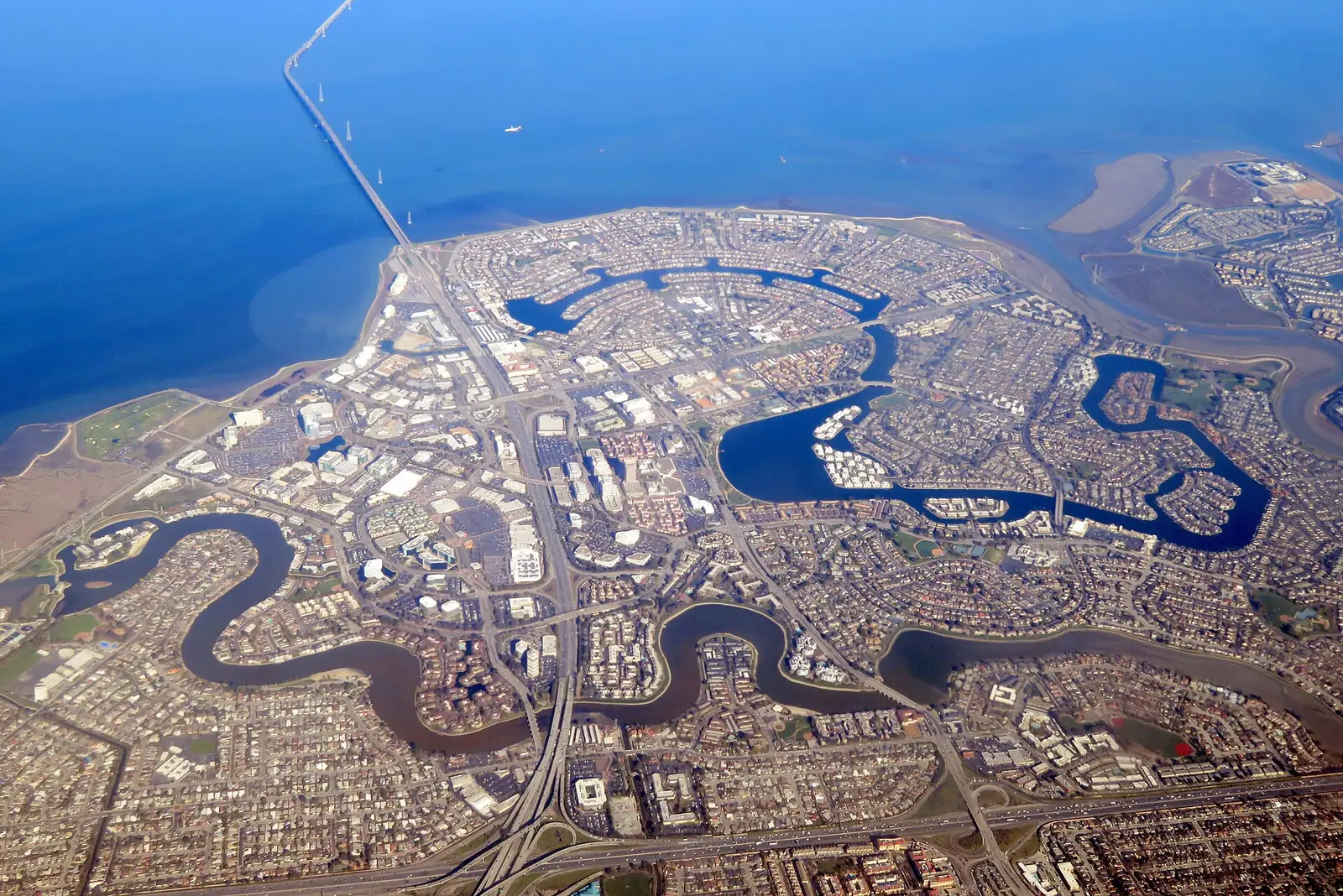
EMID's only supply is the San Francisco Regional Water System, delivered through a turnout on Crystal Springs Road in San Mateo into storage tanks in the northwest corner of the district, which also serves part of San Mateo. Under EMID's code, the customer's water facilities are the owner's to repair and replace, including damage to the meter box or piping caused by tree roots, fencing or landscaping around it.
Can I tie my downspouts into the sewer or drain the pool into it?
Downspouts, no: EMID's code bars roof leaders and surface drains from any sanitary sewer, along with seepage and other unpolluted water. A swimming pool may be emptied into the sanitary sewer only at no more than 100 gallons per minute, and only through an approved separator that keeps sewage from backing up into the pool.